Ch. 5 - Complex Numbers, Polar Coordinates and Parametric Equations
Blitzer - Trigonometry 3rd Edition
Blitzer3rd EditionTrigonometryISBN: 9780137316601Not the one you use?Change textbook
Chapter 5, Problem 34

In Exercises 21–40, eliminate the parameter t. Then use the rectangular equation to sketch the plane curve represented by the given parametric equations. Use arrows to show the orientation of the curve corresponding to increasing values of t. (If an interval for t is not specified, assume that −∞ < t < ∞.


x = 2 + 4 cos t, y = −1 + 3 sin t; 0 ≤ t ≤ π

Verified step by step guidance
1
Identify the given parametric equations: \(x = 2 + 4 \cos t\) and \(y = -1 + 3 \sin t\), with the parameter \(t\) in the interval \(0 \leq t \leq \pi\).
Express \(\cos t\) and \(\sin t\) in terms of \(x\) and \(y\) by isolating them from the parametric equations: \(\cos t = \frac{x - 2}{4}\) and \(\sin t = \frac{y + 1}{3}\).
Use the Pythagorean identity \(\sin^2 t + \cos^2 t = 1\) to eliminate the parameter \(t\). Substitute the expressions for \(\cos t\) and \(\sin t\) into this identity:
\[\left(\frac{x - 2}{4}\right)^2 + \left(\frac{y + 1}{3}\right)^2 = 1.\]
Recognize that this equation represents an ellipse centered at \((2, -1)\) with semi-major axis 4 along the \(x\)-direction and semi-minor axis 3 along the \(y\)-direction. To sketch the curve, plot this ellipse and indicate the orientation by considering the direction of increasing \(t\) from \(0\) to \(\pi\), which corresponds to moving from the point where \(t=0\) (start) to \(t=\pi\) (end) along the ellipse.

Verified video answer for a similar problem:

This video solution was recommended by our tutors as helpful for the problem above.
Video duration:
8m
Was this helpful?

Key Concepts

Here are the essential concepts you must grasp in order to answer the question correctly.

Parametric Equations

Parametric equations express the coordinates of points on a curve as functions of a parameter, often denoted t. Instead of y as a function of x, both x and y depend on t, allowing the description of more complex curves and motions. Understanding how to manipulate these equations is essential for eliminating the parameter and analyzing the curve.
Recommended video:
08:02
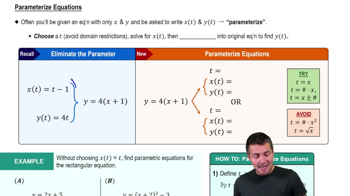
Parameterizing Equations

Eliminating the Parameter

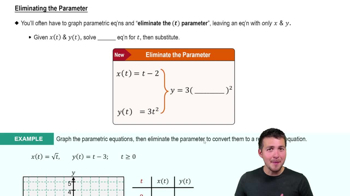
Eliminating the parameter involves rewriting the parametric equations to form a single equation in x and y, removing t. This often uses trigonometric identities or algebraic manipulation, enabling the curve to be expressed in rectangular form. This step is crucial for sketching and understanding the geometric shape of the curve.
Recommended video:
05:59
Eliminating the Parameter

Orientation and Interval of the Parameter

The orientation of a parametric curve indicates the direction in which the curve is traced as the parameter t increases. The given interval for t (0 ≤ t ≤ π) restricts the portion of the curve to be considered. Arrows on the sketch show this direction, helping to visualize the motion or progression along the curve.
Recommended video:
05:59
Eliminating the Parameter