Ch. 1 - Angles and the Trigonometric Functions
Blitzer - Trigonometry 3rd Edition
Blitzer3rd EditionTrigonometryISBN: 9780137316601Not the one you use?Change textbook
Chapter 1, Problem 6

In Exercises 5–18, the unit circle has been divided into twelve equal arcs, corresponding to t-values of 0, πœ‹, πœ‹, πœ‹, 2πœ‹, 5πœ‹, πœ‹, 7πœ‹, 4πœ‹, 3πœ‹, 5πœ‹, 11πœ‹, and 2πœ‹. 6 3 2 3 6 6 3 2 3 6 Use the (x,y) coordinates in the figure to find the value of each trigonometric function at the indicated real number, t, or state that the expression is undefined. sin πœ‹/3

Verified step by step guidance
1
Recall that on the unit circle, the sine of an angle \( t \) corresponds to the y-coordinate of the point on the circle at that angle.
Identify the angle \( t = \frac{\pi}{3} \) on the unit circle. Since the circle is divided into twelve equal arcs, each arc corresponds to \( \frac{2\pi}{12} = \frac{\pi}{6} \).
Determine the coordinates of the point on the unit circle at \( t = \frac{\pi}{3} \). This angle is twice \( \frac{\pi}{6} \), so it corresponds to the second division point.
Recall or use the known exact coordinates for \( \frac{\pi}{3} \) on the unit circle, which are \( \left( \frac{1}{2}, \frac{\sqrt{3}}{2} \right) \).
Since sine corresponds to the y-coordinate, the value of \( \sin \frac{\pi}{3} \) is \( \frac{\sqrt{3}}{2} \).

Verified video answer for a similar problem:

This video solution was recommended by our tutors as helpful for the problem above.
Was this helpful?

Key Concepts

Here are the essential concepts you must grasp in order to answer the question correctly.

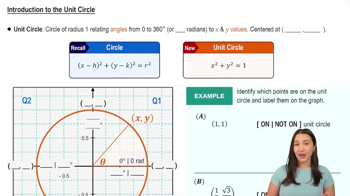
Unit Circle and Radian Measure

The unit circle is a circle with radius 1 centered at the origin of the coordinate plane. Angles on the unit circle are measured in radians, where 2Ο€ radians correspond to a full rotation (360Β°). Each point on the unit circle corresponds to an angle t, and its coordinates (x, y) represent (cos t, sin t). Understanding this relationship is essential for evaluating trigonometric functions at given radian values.
Recommended video:
06:11
Introduction to the Unit Circle

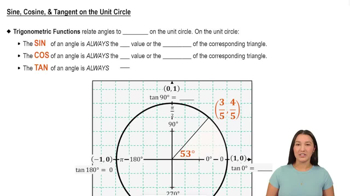
Sine Function on the Unit Circle

The sine of an angle t is the y-coordinate of the corresponding point on the unit circle. For example, sin(Ο€/3) corresponds to the y-value of the point at an angle of Ο€/3 radians. Knowing the exact coordinates of common angles like Ο€/3 helps in directly finding sine values without a calculator.
Recommended video:
6:34
Sine, Cosine, & Tangent on the Unit Circle

Special Angles and Their Coordinates

Special angles such as Ο€/6, Ο€/4, and Ο€/3 have well-known sine and cosine values derived from their coordinates on the unit circle. For Ο€/3, the coordinates are (1/2, √3/2), so sin(Ο€/3) = √3/2. Memorizing these values or understanding how to derive them from the unit circle simplifies solving trigonometric problems.
Recommended video:
05:32
Intro to Polar Coordinates