Ch. 2 - Graphs of the Trigonometric Functions; Inverse Trigonometric Functions
Blitzer - Trigonometry 3rd Edition
Blitzer3rd EditionTrigonometryISBN: 9780137316601Not the one you use?Change textbook
Chapter 2, Problem 29

In Exercises 29–36, find the length x to the nearest whole unit.

Verified step by step guidance
1
Identify the type of triangle involved in the problem (right triangle, oblique triangle, etc.) and the given information such as angles and side lengths.
Choose the appropriate trigonometric ratio or law based on the given information. For right triangles, use sine, cosine, or tangent: \(\sin \theta = \frac{\text{opposite}}{\text{hypotenuse}}\), \(\cos \theta = \frac{\text{adjacent}}{\text{hypotenuse}}\), or \(\tan \theta = \frac{\text{opposite}}{\text{adjacent}}\). For non-right triangles, consider the Law of Sines or Law of Cosines.
Set up an equation using the chosen trigonometric ratio or law, substituting the known values and the variable \(x\) for the unknown side length.
Solve the equation algebraically to isolate \(x\). This may involve multiplying both sides, dividing, or using inverse trigonometric functions if angles need to be found first.
Once you have the expression for \(x\), round the result to the nearest whole unit as requested.

Verified video answer for a similar problem:

This video solution was recommended by our tutors as helpful for the problem above.
Video duration:
4m
Was this helpful?

Key Concepts

Here are the essential concepts you must grasp in order to answer the question correctly.

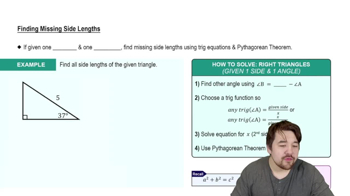
Right Triangle Side Lengths

Understanding how to find unknown side lengths in right triangles is fundamental. This often involves using relationships between the sides, such as the Pythagorean theorem or trigonometric ratios, to solve for the missing length.
Recommended video:
4:18
Finding Missing Side Lengths

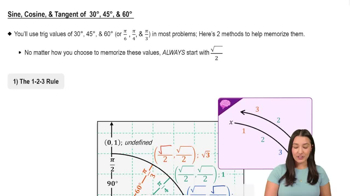
Trigonometric Ratios (Sine, Cosine, Tangent)

Sine, cosine, and tangent relate the angles of a right triangle to the ratios of its sides. Knowing which ratio to use depends on the given angle and sides, enabling calculation of unknown lengths when an angle and one side are known.
Recommended video:
5:08
Sine, Cosine, & Tangent of 30°, 45°, & 60°

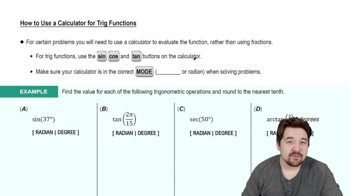
Rounding and Approximation

After calculating the length x, rounding to the nearest whole unit is necessary for practical answers. This involves understanding decimal values and applying standard rounding rules to present the solution clearly and accurately.
Recommended video:
4:45
How to Use a Calculator for Trig Functions