In Exercises 55–58, use a calculator to find the value of the acute angle θ to the nearest degree. sin θ = 0.2974
Ch. 1 - Angles and the Trigonometric Functions

Chapter 1, Problem 1
In Exercises 1–8, use the Pythagorean Theorem to find the length of the missing side of each right triangle. Then find the value of each of the six trigonometric functions of θ.

Verified step by step guidance1
Identify the sides of the right triangle relative to angle \( \theta \) at vertex Q: the side opposite \( \theta \) is \( 3 \), the side adjacent to \( \theta \) is \( 4 \), and the hypotenuse \( PQ \) is unknown.
Use the Pythagorean Theorem to find the hypotenuse \( PQ \): \( PQ^2 = QR^2 + PR^2 \), which translates to \( PQ^2 = 4^2 + 3^2 \).
Calculate \( PQ \) by taking the square root of the sum: \( PQ = \sqrt{4^2 + 3^2} \). This gives the length of the hypotenuse.
Find the six trigonometric functions of \( \theta \) using the side lengths:
- Sine: \( \sin \theta = \frac{\text{opposite}}{\text{hypotenuse}} = \frac{3}{PQ} \)
- Cosine: \( \cos \theta = \frac{\text{adjacent}}{\text{hypotenuse}} = \frac{4}{PQ} \)
- Tangent: \( \tan \theta = \frac{\text{opposite}}{\text{adjacent}} = \frac{3}{4} \)
Use the reciprocal identities to find the remaining three functions:
- Cosecant: \( \csc \theta = \frac{1}{\sin \theta} = \frac{PQ}{3} \)
- Secant: \( \sec \theta = \frac{1}{\cos \theta} = \frac{PQ}{4} \)
- Cotangent: \( \cot \theta = \frac{1}{\tan \theta} = \frac{4}{3} \)

Verified video answer for a similar problem:
This video solution was recommended by our tutors as helpful for the problem above.
Video duration:
4mWas this helpful?
Key Concepts
Here are the essential concepts you must grasp in order to answer the question correctly.
Pythagorean Theorem
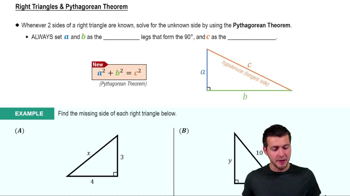
The Pythagorean Theorem states that in a right triangle, the square of the hypotenuse (the side opposite the right angle) equals the sum of the squares of the other two sides. It is expressed as a² + b² = c². This theorem is essential for finding the missing side length when two sides are known.
Recommended video:
Solving Right Triangles with the Pythagorean Theorem
Right Triangle Trigonometric Functions
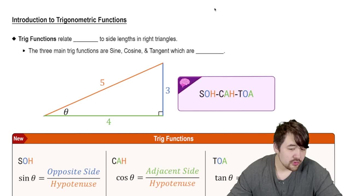
The six trigonometric functions (sine, cosine, tangent, cosecant, secant, and cotangent) relate the angles of a right triangle to the ratios of its sides. For an angle θ, sine is opposite/hypotenuse, cosine is adjacent/hypotenuse, and tangent is opposite/adjacent. The reciprocal functions are cosecant, secant, and cotangent.
Recommended video:
Introduction to Trigonometric Functions
Identifying Sides Relative to an Angle
In a right triangle, the sides are classified relative to the angle of interest: the opposite side is across from the angle, the adjacent side is next to the angle (but not the hypotenuse), and the hypotenuse is the longest side opposite the right angle. Correctly identifying these sides is crucial for applying trigonometric functions.
Recommended video:
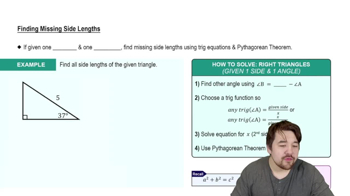
Finding Missing Side Lengths
Related Practice
Textbook Question
685
views
Textbook Question
In Exercises 57–70, find a positive angle less than or that is coterminal with the given angle. -150°
563
views
Textbook Question
In Exercises 55–58, use a calculator to find the value of the acute angle θ to the nearest degree. tan θ = 4.6252
630
views
Textbook Question
In Exercises 63–68, find the exact value of each expression. Do not use a calculator. csc 37° sec 53° - tan 53° cot 37°
595
views
Textbook Question
In Exercises 1–6, the measure of an angle is given. Classify the angle as acute, right, obtuse, or straight. 135°
807
views
Textbook Question
In Exercises 75–78, find the area of the sector of a circle of radius r formed by a central angle θ. Express area in terms of π. Then round your answer to two decimal places. Radius, r: 10 meters Central Angle, θ: θ = 18°
576
views