Ch. 3 - Trigonometric Identities and Equations
Blitzer - Trigonometry 3rd Edition
Blitzer3rd EditionTrigonometryISBN: 9780137316601Not the one you use?Change textbook
Chapter 3, Problem 17

Use a sum or difference formula to find the exact value of each expression. tan 5𝝅/12

Verified step by step guidance
1
Identify the angle given: \( \frac{5\pi}{12} \). Notice that \( \frac{5\pi}{12} \) can be expressed as a sum or difference of angles whose tangent values are known. For example, \( \frac{5\pi}{12} = \frac{\pi}{3} + \frac{\pi}{4} \) because \( \frac{\pi}{3} = \frac{4\pi}{12} \) and \( \frac{\pi}{4} = \frac{3\pi}{12} \), and their sum is \( \frac{7\pi}{12} \), so check carefully for the correct decomposition.
Find two angles \( A \) and \( B \) such that \( \frac{5\pi}{12} = A + B \) or \( A - B \), where \( A \) and \( B \) are standard angles with known tangent values. For example, \( \frac{5\pi}{12} = \frac{\pi}{4} + \frac{\pi}{6} \) because \( \frac{\pi}{4} = \frac{3\pi}{12} \) and \( \frac{\pi}{6} = \frac{2\pi}{12} \), and their sum is \( \frac{5\pi}{12} \).
Use the tangent sum formula: \( \tan(A + B) = \frac{\tan A + \tan B}{1 - \tan A \tan B} \). Substitute \( A = \frac{\pi}{4} \) and \( B = \frac{\pi}{6} \) into this formula.
Recall the exact values: \( \tan \frac{\pi}{4} = 1 \) and \( \tan \frac{\pi}{6} = \frac{1}{\sqrt{3}} \). Substitute these values into the formula to express \( \tan \frac{5\pi}{12} \) in terms of known numbers.
Simplify the resulting expression by performing the addition and subtraction in the numerator and denominator to get the exact value of \( \tan \frac{5\pi}{12} \).

Verified video answer for a similar problem:

This video solution was recommended by our tutors as helpful for the problem above.
Video duration:
5m

Key Concepts

Here are the essential concepts you must grasp in order to answer the question correctly.

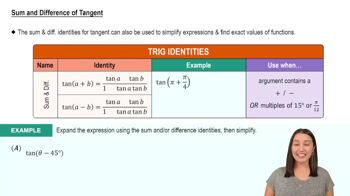
Sum and Difference Formulas for Tangent

These formulas express the tangent of a sum or difference of two angles in terms of the tangents of the individual angles. Specifically, tan(a ± b) = (tan a ± tan b) / (1 ∓ tan a tan b). They are essential for breaking down complex angles into simpler parts whose tangent values are known.
Recommended video:
4:47
Sum and Difference of Tangent

Exact Values of Tangent for Special Angles

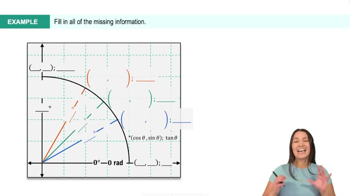
Certain angles like π/6, π/4, and π/3 have known exact tangent values (e.g., tan(π/4) = 1). Recognizing these angles helps in applying sum or difference formulas effectively to find exact values without approximations.
Recommended video:
6:04
Example 1

Angle Decomposition

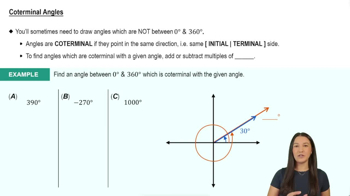
This involves expressing a given angle as a sum or difference of angles with known trigonometric values. For example, 5π/12 can be written as π/3 + π/4, enabling the use of sum formulas to find exact trigonometric values.
Recommended video:
04:46
Coterminal Angles