Funny literal translations from around the world

Charlotte Guest
Charlotte Guest
Two friends reading a book together smiling
Reading time: 3 minutes

One of the fun things about learning a new language is discovering how different cultures describe everyday objects and concepts. Sometimes, these descriptions are so literal and imaginative that they bring a smile to our faces (and maybe a few confused looks). Here are some examples of words in other languages that, when translated literally, are probably not what you expected.

Funny literal translations from around the world
Play
Privacy and cookies

By watching, you agree Pearson can share your viewership data for marketing and analytics for one year, revocable by deleting your cookies.

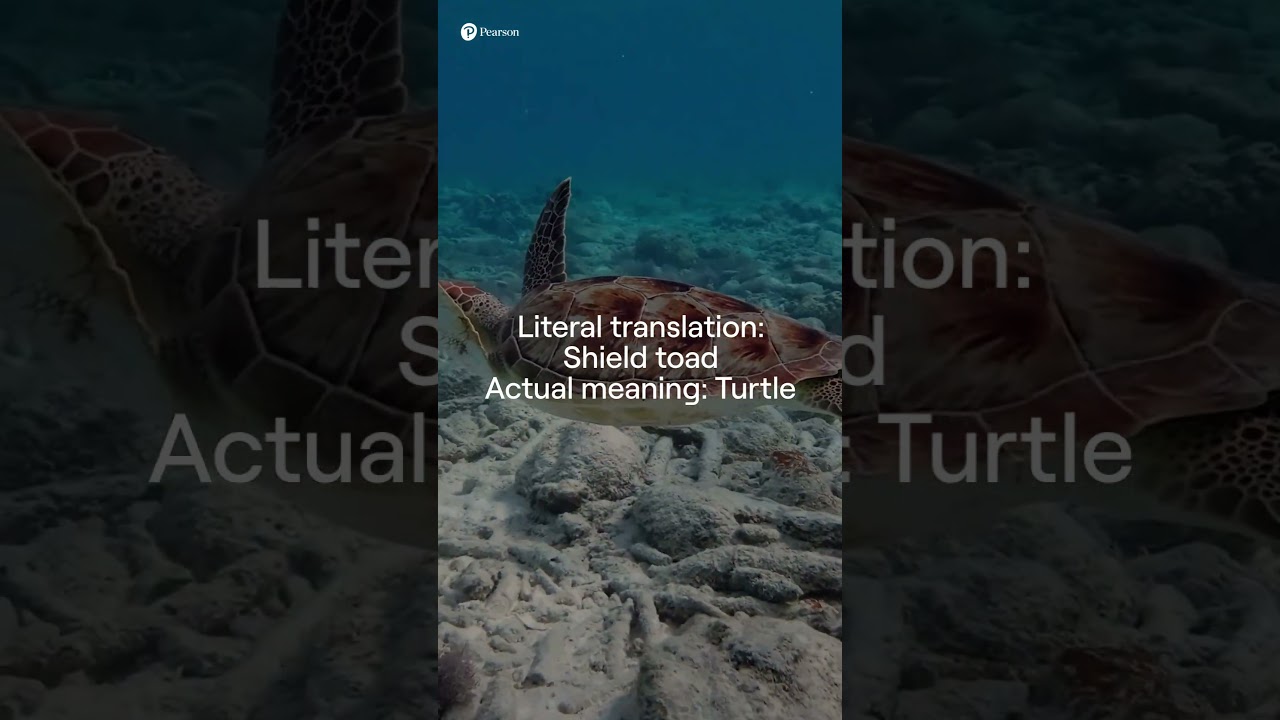
1. Schildpad (Dutch)

Literal translation: Shield Toad 

Actual meaning: Turtle

The Dutch word for turtle is "schildpad," which translates to "shield toad." It’s a descriptive term that paints a vivid picture of a turtle carrying its protective shell like a knight’s shield, even if it amusingly refers to the turtle as a toad.

2. Kummerspeck (German)

Literal translation: Grief Bacon 

Actual meaning: Excess weight gained from emotional overeating

The Germans have a knack for creating compound words that perfectly capture complex emotions. "Kummerspeck" is one such word, combining "Kummer" (grief) and "Speck" (bacon) to describe the extra pounds one might gain from comfort eating during tough times.

3. Pamplemousse (French)

Literal translation: Pompous Lemon 

Actual meaning: Grapefruit

The French word for grapefruit is "pamplemousse," which sounds like "pompous lemon." While grapefruits are indeed larger than lemons, the term adds a humorous flair to this citrus fruit.

4. Sobremesa (Spanish)

Literal translation: Over table 

Actual meaning: The time spent chatting and relaxing at the table after a meal

In Spain, meals are not just about eating; they are social events. "Sobremesa" refers to the time spent lingering at the table, enjoying conversation and company after the meal is finished.

5. Drachenfutter (German)

Literal translation: Dragon fodder 

Actual meaning: A peace offering to a partner after a quarrel

Another gem from the German language, "Drachenfutter" combines "Drache" (dragon) and "Futter" (fodder) to describe a gift given to calm an angry partner.

6. L’esprit de l’escalier (French)

Literal translation: Staircase wit 

Actual meaning: The perfect retort or comeback that one thinks of only after the moment has passed

The French phrase "l’esprit de l’escalier" describes the phenomenon of thinking of the perfect comeback too late. It’s a poetic way of expressing that frustrating moment when the right words come to you after the conversation has ended.

7. Utepils (Norwegian)

Literal translation: Outside beer 

Actual meaning: The act of enjoying a beer outdoors

In Norway, "utepils" is the delightful experience of drinking beer outside, especially when the weather is nice. It’s a word that perfectly captures the simple joy of enjoying a cold beverage in the great outdoors.

8. Backpfeifengesicht (German)

Literal translation: A face that needs a slap 

Actual meaning: A face that is begging to be slapped

9. Gattara (Italian)

Literal translation: Cat lady 

Actual meaning: An old woman who takes care of stray cats

10. Desvelado (Spanish)

Literal translation: Unveiled 

Actual meaning: Sleep-deprived

In Spanish, "desvelado" literally means "unveiled," but it’s used to describe someone who is sleep-deprived. It’s a poetic way of saying that someone’s lack of sleep has been revealed.

So, the next time you’re learning a new language, keep an eye out for these delightful gems—they’re sure to bring a smile to your face. Does your own language have any similarly amusing or descriptive words? You might be surprised at what you discover.

More blogs from Pearson

  • Teacher talking to girl working on laptop in classroom smiling
    Designed for learning, built for growth: How Big Ben Education Group reimagined short-term programs
    By Kathy Chan
    Reading time: 3 minutes

    The challenge: Creating meaningful learning in short-term programs

    In recent years, Big Ben Education Group faced a challenge: how to deliver meaningful learning within short-term programs. Although teachers were passionate and students motivated, their short-term courses lacked a clear academic structure, making learning feel rushed and less impactful. At the same time, they relied heavily on a single market and sought to attract a more diverse, global student mix.

    This raised a critical question: How do you design a short-term program that is both academically meaningful and appealing to a global student audience? That question led to the launch of their first Winter Camp in 2024.

    The turning point: From camp to structured learning experience

    The Winter Camp marked a major shift. For the first time, students from across China, Korea, Japan, Central Asia and the Middle East were brought together. Managing this level of cultural and linguistic diversity required more than enthusiasm; it required structure.

    The school introduced Big English as a core academic framework, giving teachers clarity on learning objectives and ensuring consistency across levels, even within a condensed timeframe.

    But the transformation didn’t stop in the classroom. Excursions were redesigned with clear learning goals, turning them into opportunities for real-world language application. This shift from activities to outcomes required careful planning and strong collaboration between academic and operations teams.  What emerged was something new – a structured, student-centered learning experience that balanced academic rigor with real-world engagement.

  • Students sat at a table with microphones talking
    Building fluent, confident speakers: better ways to assess speaking
    By Charlotte Guest
    Reading time: 6 minutes

    Why traditional speaking assessments can make students feel stressed

    Traditional speaking tests often feel high-stakes and performative. Students are asked to respond on demand, usually in front of a teacher or peers, with little room for hesitation or self-correction. This setup can make it harder for students to show what they can really do because:

    • Time pressure shifts focus from communicating meaning to avoiding mistakes
    • Teacher-centered evaluation can feel judgmental rather than supportive
    • One-off testing may not capture a learner's true abilitiy, especially if they're nervous. 

    When people feel anxious, it often affects their fluency. They find it harder to think so they pause more, forget words and feel less confident. As a result, assessments may reflect how comfortable someone feels under pressure, rather than how effectively they can communicate.

    Key components of speaking fluency to evaluate

    Fluency isn't just about talking fast. It involves several clear signs.

  • Two young girls fistbumping eachother in celebration
    Debunking myths about neurodivergence and language learning
    By Charlotte Guest
    Reading time: 5 minutes

    Can neurodivergent learners really learn a new language?

    Neurodivergent people can learn new languages successfully. Often, what seems like an inability is actually due to a mismatch between traditional teaching methods and how different brains process information.

    Research across ADHD, autism and dyslexia consistently shows that language learning is not only possible but can offer cognitive, social and even emotional benefits. The key variable isn’t capacity, it’s approach.

    Common myths about ADHD, autism and dyslexia in language learning

    Myth 1: “People with ADHD can’t focus enough to learn a language”

    Fact: ADHD brains often thrive with novelty, variety and stimulation all of which language learning naturally provides.

    While research on ADHD and language learning is still emerging, scholars highlight that the field is under-researched, not evidence of inability. This gap reinforces that perceived difficulties are often due to teaching methods rather than learner capacity. Traditional methods (long grammar drills, passive memorization) can fail ADHD learners. But when learning includes:

    • Short, varied activities
    • Speaking and interaction
    • Gamified tools
    • Real-world usage

    Attention often improves, not worsens.

    Reframe: It’s not a focus deficit, it’s a method mismatch.

    Myth 2: “Dyslexia makes learning another language too difficult”

    Fact: Dyslexia affects reading and decoding,  not intelligence or the ability to acquire language.

    In fact, many dyslexic learners:

    • Excel in spoken language skills
    • Develop strong pattern recognition
    • Benefit from multisensory input (audio + visual + movement)

    Difficulties usually arise when teaching is overly text-heavy.

    Reframe: Dyslexia changes how language is learned, not whether it can be learned.

    Myth 3: “Autistic learners shouldn’t be pushed into bilingualism”

    Fact: There is no evidence that learning multiple languages harms autistic individuals. Reviews have shown that bilingualism does not have negative effects on autistic children, despite long-standing misconceptions among professionals. In many cases, it can:

    • Support communication flexibility
    • Enhance social connection (especially in multilingual families)
    • Strengthen cognitive processing

    The outdated belief that bilingualism causes confusion has been widely debunked. More recent reviews also highlight cognitive, social and identity-related benefits of bilingualism in autism, challenging deficit-based assumptions. 

    Reframe: Language learning can expand communication,  not limit it.

    Myth 4: “Neurodivergent learners just need more discipline”

    Fact: What looks like “lack of effort” is often cognitive overload.

    Neurodivergent learners may struggle when:

    • Instructions are unclear
    • Tasks rely on one learning modality
    • Pacing is rigid
    • Working memory is overloaded

    Educational research shows that students are very different from each other, and teaching should change to fit those differences.

    Reframe: The issue isn’t motivation,  it’s accessibility.

    Why traditional teaching methods don’t work for every brain

    Most language classrooms still rely on:

    • Heavy text-based instruction
    • One-size-fits-all pacing
    • Passive memorization
    • Limited sensory engagement

    These approaches conflict with what we know about different ways of learning (learner modalities),  the idea that people process information differently (visual, auditory, kinesthetic, etc.).

    The modality principle of multimedia learning shows that people learn better when information is presented through multiple channels (e.g., visuals + audio instead of text alone). This is especially important for neurodivergent learners.

    Bottom line: When teaching adapts to the learner, outcomes improve dramatically.

    How educators and parents can support diverse learners

    Start with this principle: the learner is not the problem; the system might be.

    For educators:

    • Offer multiple ways to engage with content
    • Design activities that include speaking, listening, and movement
    • Avoid equating speed with ability
    • Normalize different learning paths

    For parents:

    • Focus on encouragement, not pressure
    • Choose programs that emphasize communication, not rote memorization
    • Advocate for inclusive teaching approaches in schools