Ch. 38 - Angiosperm Reproduction and Biotechnology
Campbell - Campbell Biology 11th Edition
Urry11th EditionCampbell BiologyISBN: 9789357423311Not the one you use?Change textbook
Chapter 38, Problem 5

Some dioecious species have the XY genotype for male and XX for female. After double fertilization, what would be the genotypes of the embryos and endosperm nuclei?
a. Embryo XY/endosperm XXX or embryo XX/endosperm XXY
b. Embryo XX/endosperm XX or embryo XY/endosperm XY
c. Embryo XX/endosperm XXX or embryo XY/endosperm XYY
d. Embryo XX/endosperm XXX or embryo XY/endosperm XXY

Verified step by step guidance
1
Step 1: Understand the concept of double fertilization. In flowering plants, double fertilization involves two sperm cells from the pollen grain. One sperm cell fertilizes the egg cell to form the embryo, while the other sperm cell fertilizes the central cell (which contains two nuclei) to form the triploid endosperm.
Step 2: Analyze the genetic contribution during fertilization. The male gamete contributes either an X or Y chromosome, while the female gamete contributes an X chromosome. For the central cell, the female contributes two X chromosomes (since it is diploid).
Step 3: Determine the possible genotypes of the embryo. The embryo is formed by the fusion of the egg cell (X) and one sperm cell (X or Y). This results in either XX (female embryo) or XY (male embryo).
Step 4: Determine the possible genotypes of the endosperm nuclei. The endosperm is formed by the fusion of the central cell (XX) and one sperm cell (X or Y). This results in either XXX (if the sperm contributes X) or XXY (if the sperm contributes Y).
Step 5: Match the possible combinations of embryo and endosperm genotypes with the given options. Based on the analysis, the correct combinations are: embryo XX/endosperm XXX or embryo XY/endosperm XXY.

Verified video answer for a similar problem:

This video solution was recommended by our tutors as helpful for the problem above.
Video duration:
2m
Was this helpful?

Key Concepts

Here are the essential concepts you must grasp in order to answer the question correctly.

Dioecious Species

Dioecious species are those that have distinct male and female individuals, each producing different types of gametes. In the context of plants, dioecy often involves specific sex chromosomes, such as XY for males and XX for females. Understanding this concept is crucial for predicting the genetic outcomes of fertilization events, as it determines the sex of the offspring based on the parental contributions.
Recommended video:
Guided course
03:24
Biological Species Concept

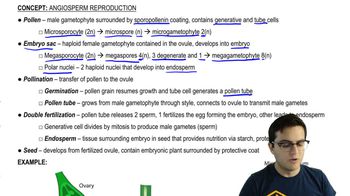
Double Fertilization

Double fertilization is a unique process in angiosperms where one sperm cell fertilizes the egg cell to form the zygote, while another sperm cell fuses with two polar nuclei to form the triploid endosperm. This endosperm provides nourishment to the developing embryo. Recognizing this process is essential for determining the genotypes of both the embryo and the endosperm in dioecious species after fertilization.
Recommended video:
07:44
Double Fertilization

Genotype and Nuclei Composition

The genotype refers to the genetic constitution of an organism, which in this case includes the sex chromosomes of the embryos and the endosperm. The composition of the endosperm nuclei is particularly important as it results from the fusion of gametes and polar nuclei. Understanding how these genetic combinations arise from the fertilization process is key to answering the question regarding the possible genotypes of the embryos and endosperm.
Recommended video:
06:36
Genotype & Phenotype
Related Practice
Textbook Question

Draw and label the parts of a flower.

1310
views
Textbook Question

Which statement concerning grafting is correct?

a. Stocks and scions refer to twigs of different species.

b. Stocks and scions must come from unrelated species.

c. Stocks provide root systems for grafting.

d. Grafting creates new species.

805
views
Textbook Question

A small flower with green petals is most likely:

a. Bee-pollinated

b. Bird-pollinated

c. Bat-pollinated

d. Wind-pollinated

2185
views
Textbook Question

Double fertilization means that:

a. Flowers must be pollinated twice to yield fruits and seeds

b. Every egg must receive two sperm to produce an embryo

c. One sperm is needed to fertilize the egg, and a second sperm is needed to fertilize the polar nuclei

d. Every sperm has two nuclei

1662
views
Textbook Question

'Bt maize'

a. Is resistant to various herbicides, making it practical to weed rice fields with those herbicides.

b. Contains transgenes that increase vitamin A content.

c. Includes bacterial genes that produce a toxin that reduces damage from insect pests.

d. Is a 'boron (B)-tolerant' transgenic variety of maize.

969
views
Textbook Question

The black dots that cover strawberries are actually fruits formed from the separate carpels of a single flower. The fleshy and tasty portion of a strawberry derives from the receptacle of a flower with many separate carpels. Therefore, a strawberry is:

a. A simple fruit with many seeds

b. Both a multiple fruit and an accessory fruit

c. Both a simple fruit and an aggregate fruit

d. Both an aggregate fruit and an accessory fruit

2238
views