Ch 02: Kinematics in One Dimension
Knight Calc - Physics for Scientists and Engineers 5th Edition
Knight Calc5th EditionPhysics for Scientists and EngineersISBN: 9780137344796Not the one you use?Change textbook
Chapter 2, Problem 9a

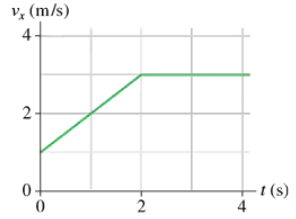
FIGURE EX2.9 shows the velocity graph of a particle. Draw the particle's acceleration graph for the interval 0 s ≤ t ≤ 4 s.

Verified step by step guidance
1
Step 1: Understand the relationship between velocity and acceleration. Acceleration is the rate of change of velocity with respect to time, mathematically expressed as \( a = \frac{dv}{dt} \). This means the slope of the velocity-time graph represents the acceleration.
Step 2: Analyze the velocity graph provided. The graph has three distinct segments: (1) from \( t = 0 \) to \( t = 5 \), the velocity increases linearly, (2) from \( t = 5 \) to \( t = 7 \), the velocity decreases linearly, and (3) from \( t = 7 \) to \( t = 10 \), the velocity remains constant.
Step 3: Calculate the slope for each segment to determine the acceleration. For \( t = 0 \) to \( t = 5 \), the slope is \( \frac{\Delta v}{\Delta t} = \frac{8 - 0}{5 - 0} = 1.6 \, \text{m/s}^2 \). For \( t = 5 \) to \( t = 7 \), the slope is \( \frac{\Delta v}{\Delta t} = \frac{8 - 6}{7 - 5} = -1 \, \text{m/s}^2 \). For \( t = 7 \) to \( t = 10 \), the slope is \( \frac{\Delta v}{\Delta t} = \frac{6 - 6}{10 - 7} = 0 \, \text{m/s}^2 \).
Step 4: Draw the acceleration graph based on the calculated slopes. For \( t = 0 \) to \( t = 5 \), plot a horizontal line at \( a = 1.6 \). For \( t = 5 \) to \( t = 7 \), plot a horizontal line at \( a = -1 \). For \( t = 7 \) to \( t = 10 \), plot a horizontal line at \( a = 0 \).
Step 5: Label the axes of the acceleration graph. The x-axis represents time \( t \) in seconds, and the y-axis represents acceleration \( a \) in \( \text{m/s}^2 \). Ensure the graph reflects the calculated values for each interval.

Verified video answer for a similar problem:

This video solution was recommended by our tutors as helpful for the problem above.
Video duration:
9m
Was this helpful?

Key Concepts

Here are the essential concepts you must grasp in order to answer the question correctly.

Velocity

Velocity is a vector quantity that describes the rate of change of an object's position with respect to time. It has both magnitude and direction, typically expressed in meters per second (m/s). In the context of the provided graph, the velocity of the particle varies over time, indicating how fast and in which direction the particle is moving at any given moment.
Recommended video:
Guided course
7:27
Escape Velocity

Acceleration

Acceleration is the rate of change of velocity over time, measured in meters per second squared (m/s²). It indicates how quickly an object is speeding up or slowing down. To derive the acceleration graph from the velocity graph, one must analyze the slope of the velocity curve; a positive slope indicates positive acceleration, while a negative slope indicates deceleration.
Recommended video:
Guided course
05:47
Intro to Acceleration

Graph Interpretation

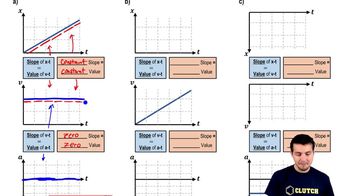
Interpreting graphs is crucial in physics as it allows for the visualization of relationships between variables. In this case, the velocity-time graph provides insights into the motion of the particle, such as periods of constant velocity, acceleration, and deceleration. Understanding how to read and analyze these graphs is essential for accurately determining the corresponding acceleration graph.
Recommended video:
Guided course
07:32
Graphing Position, Velocity, and Acceleration Graphs