Which of the following ligaments does not attach to the ovaries? a. Lateral cervical ligaments b. Broad ligament c. Ovarian ligament d. Suspensory ligament e. All of these attach to the ovaries
Verified step by step guidance
1
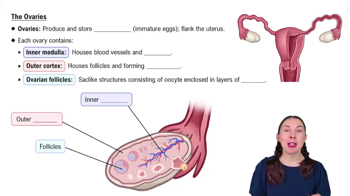
Understand the anatomy of the ovaries and their associated ligaments. The ovaries are connected to other structures in the pelvic cavity by several ligaments that provide support and maintain their position.
Review the function and attachment points of each ligament mentioned in the question: (a) Lateral cervical ligaments, (b) Broad ligament, (c) Ovarian ligament, and (d) Suspensory ligament.
Recall that the ovarian ligament directly connects the ovary to the uterus, while the suspensory ligament attaches the ovary to the lateral pelvic wall and contains blood vessels, lymphatics, and nerves.
Note that the broad ligament is a peritoneal fold that supports the uterus, fallopian tubes, and ovaries, but it does not directly attach to the ovaries. Instead, it forms a part of the mesovarium, which suspends the ovaries.
Conclude that the lateral cervical ligaments (also known as cardinal ligaments) primarily support the uterus and do not attach to the ovaries. This makes them the correct answer to the question.
Verified video answer for a similar problem:
This video solution was recommended by our tutors as helpful for the problem above
Play a video:
Was this helpful?
Key Concepts
Here are the essential concepts you must grasp in order to answer the question correctly.
Anatomy of the Female Reproductive System
Understanding the anatomy of the female reproductive system is crucial for identifying the ligaments associated with the ovaries. The ovaries are connected to various ligaments that support their position and function, including the broad ligament, ovarian ligament, and suspensory ligament. Knowledge of these structures helps in determining which ligaments do or do not attach to the ovaries.
Anatomy of the Female Reproductive System Example 8
Ligaments of the Ovaries
The ligaments associated with the ovaries include the ovarian ligament, which directly connects the ovaries to the uterus, and the suspensory ligament, which connects the ovaries to the lateral pelvic wall. The broad ligament, while it supports the reproductive organs, does not attach directly to the ovaries but rather envelops them. Recognizing these distinctions is essential for answering the question accurately.
Ligaments in the reproductive system serve to stabilize and support the organs, maintaining their position within the pelvic cavity. Each ligament has a specific role; for instance, the suspensory ligament contains blood vessels supplying the ovaries. Understanding the functional roles of these ligaments aids in comprehending their anatomical relationships and relevance to the question posed.