When the alveolar Pco₂ decreases, the pulmonary arterioles_____. When the arteriolar Pco₂ increases, the bronchioles_______.
Ch. 21 The Respiratory System
Chapter 21, Problem 14c
Mark the following statements as true or false. If a statement is false, correct it to make a true statement.
Hb in arterial blood is normally almost fully saturated.
Verified step by step guidance1
Step 1: Understand the context of the problem. The question is asking about hemoglobin (Hb) saturation in arterial blood, which refers to the percentage of hemoglobin molecules bound to oxygen in the blood traveling away from the lungs to the tissues.
Step 2: Recall the physiological concept of oxygen transport. Hemoglobin in arterial blood is typically highly saturated with oxygen because it has just passed through the lungs, where oxygen is abundant. This saturation is usually around 95-98% under normal conditions.
Step 3: Evaluate the statement provided. The statement 'Hb in arterial blood is normally almost fully saturated' aligns with the physiological norm, as arterial blood is indeed almost fully saturated with oxygen.
Step 4: Determine whether the statement is true or false. Based on the physiological explanation, the statement is true. If it were false, you would need to correct it by stating that arterial hemoglobin is normally almost fully saturated with oxygen.
Step 5: Conclude the analysis. Since the statement is true, no correction is needed. If the statement were false, you would rewrite it to reflect the normal saturation levels of hemoglobin in arterial blood.

Verified video answer for a similar problem:
This video solution was recommended by our tutors as helpful for the problem above.
Video duration:
5mWas this helpful?
Key Concepts
Here are the essential concepts you must grasp in order to answer the question correctly.
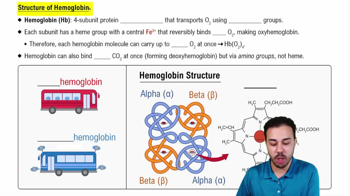
Hemoglobin Saturation
Hemoglobin saturation refers to the percentage of hemoglobin molecules in the blood that are bound to oxygen. In healthy individuals, arterial blood typically shows a saturation level of about 95-100%, indicating that hemoglobin is almost fully saturated with oxygen, which is crucial for efficient oxygen transport to tissues.
Recommended video:
Structure of Hemoglobin
Arterial Blood Gases (ABG)
Arterial blood gases are tests that measure the levels of oxygen and carbon dioxide in the blood, as well as the blood's pH. These measurements are essential for assessing respiratory function and the effectiveness of oxygen delivery, providing insight into the saturation of hemoglobin in arterial blood.
Recommended video:
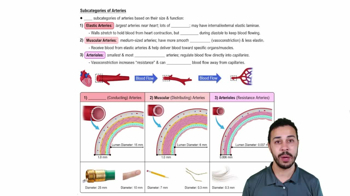
Subcategories of Arteries
Oxygen Transport
Oxygen transport is the process by which oxygen is carried from the lungs to the tissues via the bloodstream. Hemoglobin plays a vital role in this process by binding to oxygen in the lungs and releasing it in the tissues, making understanding its saturation levels critical for evaluating respiratory and circulatory health.
Recommended video:
Active Transport
Related Practice
Textbook Question
825
views
Textbook Question
Mark the following statements as true or false. If a statement is false, correct it to make a true statement.
Increased PCO2, temperature, and hydrogen ion concentration all increase Hb's affinity for oxygen.
114
views
Textbook Question
Mark the following statements as true or false. If a statement is false, correct it to make a true statement.
Each Hb protein can carry up to four oxygen molecules.
116
views
Textbook Question
Mark the following statements as true or false. If a statement is false, correct it to make a true statement.
Oxygen is transported primarily by dissolving in the plasma.
112
views
Textbook Question
Mark the following statements as true or false. If a statement is false, correct it to make a true statement.
When the PO₂ of arterial blood drops slightly, the percent saturation of Hb drops dramatically.
95
views