
Ch. 16 The Endocrine System
Amerman - Human Anatomy & Physiology 2nd Edition
Amerman2nd EditionHuman Anatomy & PhysiologyISBN: 9780136873822Not the one you use?Change textbook
Chapter 16, Problem 1d

Mark the following statements as true or false. If a statement is false, correct it to make a true statement.
Steroid hormones are hydrophilic molecules that bind to plasma membrane proteins as part of a second-messenger system.

Verified step by step guidance
1
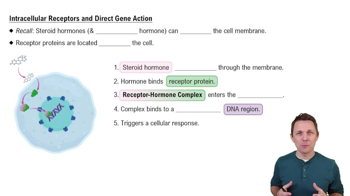
Step 1: Understand the nature of steroid hormones. Steroid hormones are lipophilic (fat-soluble) molecules, not hydrophilic. This means they can easily pass through the lipid bilayer of the plasma membrane without requiring membrane proteins for transport.
Step 2: Recognize how steroid hormones interact with cells. Since steroid hormones are lipophilic, they typically bind to intracellular receptors located in the cytoplasm or nucleus, rather than plasma membrane proteins.
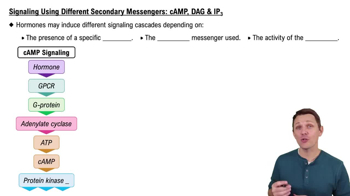
Step 3: Learn about second-messenger systems. Second-messenger systems are typically used by hydrophilic hormones (e.g., peptide hormones) that cannot cross the plasma membrane. These systems involve the binding of the hormone to a membrane receptor, which then activates intracellular signaling pathways.
Step 4: Correct the false statement. The corrected statement should read: 'Steroid hormones are lipophilic molecules that bind to intracellular receptors to directly influence gene expression.'
Step 5: Review the distinction between hydrophilic and lipophilic hormones to reinforce understanding. Hydrophilic hormones use second-messenger systems, while lipophilic hormones like steroids directly interact with intracellular receptors.

Verified video answer for a similar problem:

This video solution was recommended by our tutors as helpful for the problem above.
Was this helpful?

Key Concepts

Here are the essential concepts you must grasp in order to answer the question correctly.

Steroid Hormones

Steroid hormones are lipophilic (fat-soluble) molecules derived from cholesterol. Unlike hydrophilic hormones, they can easily pass through cell membranes and typically bind to intracellular receptors, leading to direct effects on gene expression. This characteristic distinguishes them from peptide hormones, which rely on membrane-bound receptors.
Recommended video:
Guided course
5:13
Actions of Steroid Hormones

Hydrophilic vs. Lipophilic

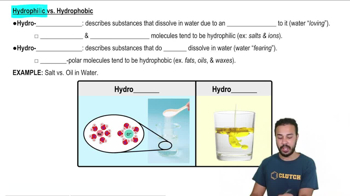
Hydrophilic molecules are water-soluble and cannot easily cross cell membranes, often requiring receptor-mediated signaling. In contrast, lipophilic molecules, like steroid hormones, can diffuse through lipid membranes and interact with receptors inside the cell. Understanding this distinction is crucial for grasping how different hormones exert their effects.
Recommended video:
03:43
Hydrophilic vs. Hydrophobic

Second-Messenger System

The second-messenger system is a signaling mechanism used primarily by hydrophilic hormones. When these hormones bind to receptors on the cell surface, they activate intracellular signaling pathways through secondary molecules, such as cyclic AMP (cAMP). This system amplifies the signal and leads to various cellular responses, contrasting with the direct action of steroid hormones.
Recommended video:
Guided course
10:41
Secondary Messengers