
Textbook Question
Mark the following statements as true or false. If a statement is false, correct it to make a true statement.
The tunica intima is composed of a sheet of endothelium, connective tissue, and the internal elastic lamina.
818
views
 Verified step by step guidance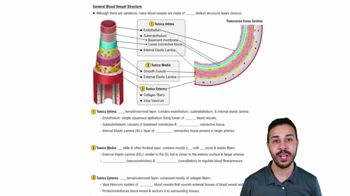
 14:36
14:36
 2:25
2:25 06:27
06:27Mark the following statements as true or false. If a statement is false, correct it to make a true statement.
The tunica intima is composed of a sheet of endothelium, connective tissue, and the internal elastic lamina.
Mark the following statements as true or false. If a statement is false, correct it to make a true statement.
The pulmonary circuit delivers blood from the right side of the heart to the lungs to become oxygenated.
Mark the following statements as true or false. If a statement is false, correct it to make a true statement.
Muscular arteries control blood flow at the tissue level.
Mark the following statements as true or false. If a statement is false, correct it to make a true statement.
Veins have smaller lumens, more elastic fibers, and more smooth muscle than arteries.
Mark the following statements as true or false. If a statement is false, correct it to make a true statement.
Arteries always carry oxygenated blood away from the heart, and veins always carry deoxygenated blood toward the heart.
Mark the following statements as true or false. If a statement is false, correct it to make a true statement.
Arteries are the exchange vessels of the cardiovascular system.