Ch. 4 Histology
Amerman - Human Anatomy & Physiology 2nd Edition
Amerman2nd EditionHuman Anatomy & PhysiologyISBN: 9780136873822Not the one you use?Change textbook
Chapter 4, Problem 13a

Each of the following statements is false. Correct each to make a true statement.
Mucous membranes are composed of mesothelium and the underlying loose connective tissue.

Verified step by step guidance
1
Understand the definition of mucous membranes: Mucous membranes are specialized tissues that line body cavities and passageways that open to the exterior, such as the respiratory, digestive, urinary, and reproductive tracts. They are involved in secretion and absorption.
Identify the correct tissue composition of mucous membranes: Mucous membranes are composed of an epithelial layer (which varies depending on the location, e.g., simple columnar, pseudostratified columnar, or stratified squamous epithelium) and an underlying layer of loose connective tissue called the lamina propria.
Recognize the error in the original statement: The original statement incorrectly states that mucous membranes are composed of mesothelium. Mesothelium is a type of simple squamous epithelium that lines serous membranes, not mucous membranes.
Correct the statement: Replace 'mesothelium' with the appropriate epithelial tissue type (e.g., simple columnar, pseudostratified columnar, or stratified squamous epithelium) and include the lamina propria as the connective tissue component.
Revised statement: 'Mucous membranes are composed of an epithelial layer (such as simple columnar epithelium) and the underlying loose connective tissue called the lamina propria.'

Verified video answer for a similar problem:

This video solution was recommended by our tutors as helpful for the problem above.
Was this helpful?

Key Concepts

Here are the essential concepts you must grasp in order to answer the question correctly.

Mucous Membranes

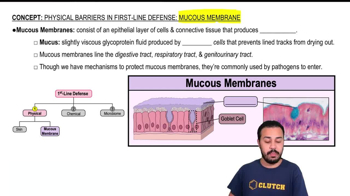
Mucous membranes are specialized epithelial tissues that line various cavities and structures in the body, including the respiratory, digestive, and urogenital tracts. They consist of an epithelial layer, which can be either simple or stratified, and an underlying layer of loose connective tissue known as the lamina propria. Their primary function is to secrete mucus, which lubricates and protects the surfaces they cover.
Recommended video:
2:36
Mucous Membranes

Mesothelium

Mesothelium is a specific type of simple squamous epithelium that lines the serous cavities of the body, such as the pleura, peritoneum, and pericardium. It serves as a protective layer and facilitates movement between organs by secreting serous fluid. Unlike mucous membranes, mesothelium does not produce mucus and is not involved in the lining of the respiratory or digestive tracts.

Loose Connective Tissue

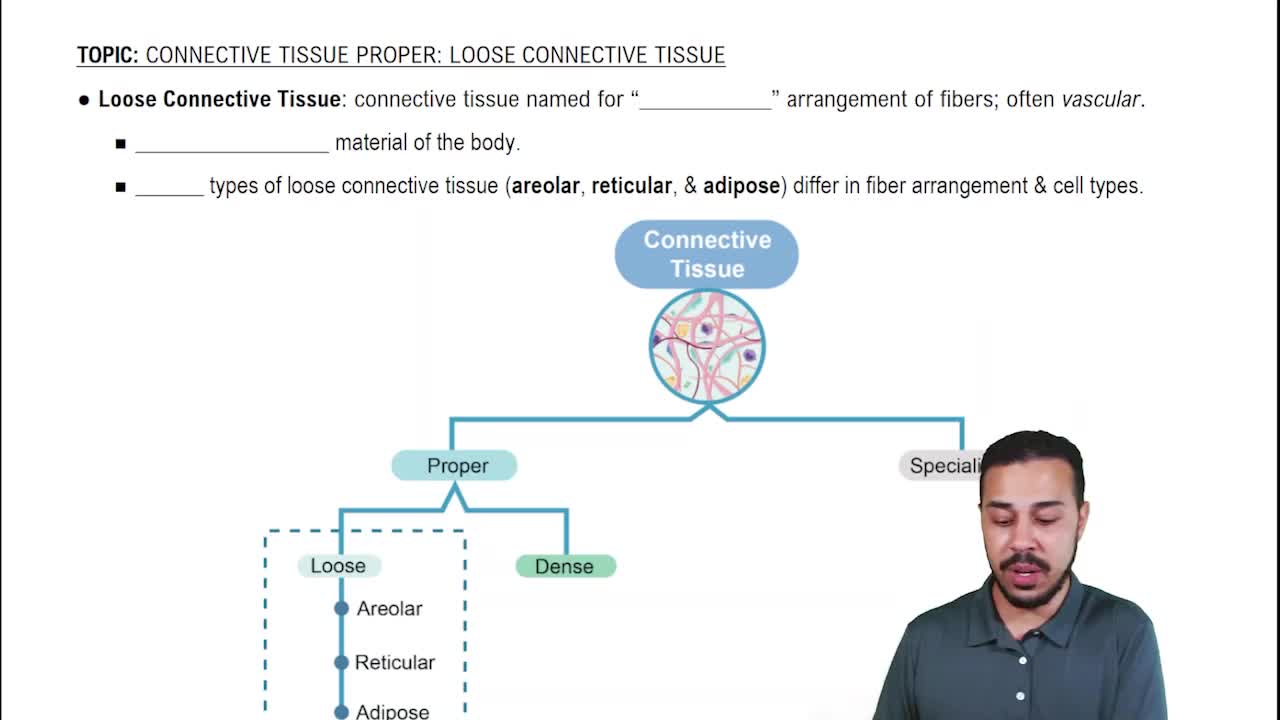
Loose connective tissue is a type of connective tissue characterized by a relatively high proportion of ground substance and fewer fibers, allowing for flexibility and support. It serves as a binding material that holds organs in place and provides a medium for the exchange of nutrients and waste. In the context of mucous membranes, the loose connective tissue layer supports the epithelial layer and contains blood vessels, nerves, and immune cells.
Recommended video:
Guided course
02:46
Loose Connective Tissue
Related Practice
Textbook Question

Each of the following statements is false. Correct each to make a true statement.

The cutaneous membrane is composed of simple squamous epithelium, loose connective tissue, and dense irregular connective tissue.

809
views
Textbook Question

Which of the following statements about muscle tissue is false?

a. Smooth muscle tissue is involuntary, and the cells are nonstriated.

b. Cardiac muscle tissue is involuntary, and the cells are striated.

c. Skeletal muscle fibers are joined by intercalated discs.

d. Skeletal muscle fibers are long and cylindrical striated cells.

1114
views
Textbook Question

Match the following types of connective tissue with their correct location(s). 

Hyaline cartilage           

Elastic cartilage           

Smooth muscle           

Dense irregular connective tissue           

Fibrocartilage

Cardiac muscle

Dense regular elastic tissue

Reticular connective tissue 

a. Dermis, surrounding joints, organs

b. Most hollow organs, eye, skin

c. Large arteries, certain ligaments

d. Ear and epiglottis

e. Lymph nodes, spleen, liver

f. Freely moveable joints

g. Intervertebral discs, knee joint

h. Heart

1230
views
Textbook Question

Each of the following statements is false. Correct each to make a true statement.

Mesothelial cells secrete mucus.

796
views
Textbook Question

____are the cells of nervous tissue that send and receive messages, and ____ are the supporting cells of nervous tissue.

An ____ carries a nerve impulse toward a neuron cell body, and a(n) ____carries a nerve impulse away from a neuron cell body.

1003
views
Textbook Question

Each of the following statements is false. Correct each to make a true statement.

Synoviocytes are the secretory cells of mucosae.

742
views