Ch. 24 The Urinary System
Amerman - Human Anatomy & Physiology 2nd Edition
Amerman2nd EditionHuman Anatomy & PhysiologyISBN: 9780136873822Not the one you use?Change textbook
Chapter 24, Problem 7b

Mark the following statements as true or false. If a statement is false, correct it to make a true statement.
b. The distal tubule reabsorbs sodium ions and secretes potassium and hydrogen ions in response to ADH.

Verified step by step guidance
1
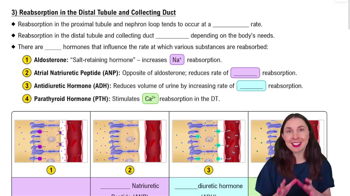
Understand the role of the distal tubule in the nephron. The distal tubule is involved in the reabsorption of sodium ions (Na⁺) and the secretion of potassium ions (K⁺) and hydrogen ions (H⁺). This process is regulated by hormones such as aldosterone and antidiuretic hormone (ADH).
Review the function of ADH (antidiuretic hormone). ADH primarily acts on the collecting ducts of the nephron to increase water reabsorption by making the ducts more permeable to water. It does not directly regulate the secretion of potassium or hydrogen ions in the distal tubule.
Identify the hormone responsible for regulating sodium reabsorption and potassium secretion in the distal tubule. Aldosterone, not ADH, is the hormone that stimulates the reabsorption of sodium ions and the secretion of potassium and hydrogen ions in the distal tubule.
Evaluate the statement: 'The distal tubule reabsorbs sodium ions and secretes potassium and hydrogen ions in response to ADH.' This statement is false because ADH does not regulate these processes in the distal tubule; aldosterone does.
Correct the false statement: 'The distal tubule reabsorbs sodium ions and secretes potassium and hydrogen ions in response to aldosterone, not ADH.'

Verified video answer for a similar problem:

This video solution was recommended by our tutors as helpful for the problem above.
Was this helpful?

Key Concepts

Here are the essential concepts you must grasp in order to answer the question correctly.

Distal Tubule Function

The distal tubule is a segment of the nephron in the kidney responsible for the reabsorption of sodium ions and the secretion of potassium and hydrogen ions. This process is crucial for maintaining electrolyte balance and regulating blood pressure. The distal tubule's activity is influenced by hormones such as aldosterone, which promotes sodium reabsorption and potassium secretion.
Recommended video:
4:24
3) Reabsorption in the Distal Tubule and Collecting Duct

Antidiuretic Hormone (ADH)

Antidiuretic hormone (ADH), also known as vasopressin, is a hormone produced by the hypothalamus and released by the posterior pituitary gland. It primarily regulates water balance in the body by increasing water reabsorption in the kidneys, particularly in the collecting ducts. While ADH affects water reabsorption, it does not directly influence sodium or potassium ion transport in the distal tubule.
Recommended video:
Guided course
13:06
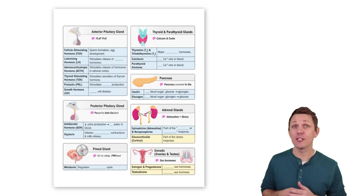
Review of Major Hormones

Hormonal Regulation of Kidney Function

The function of the kidneys is regulated by various hormones, including aldosterone and ADH. Aldosterone stimulates sodium reabsorption and potassium secretion in the distal tubule, while ADH focuses on water reabsorption. Understanding the roles of these hormones is essential for comprehending how the kidneys maintain homeostasis and respond to changes in the body's fluid and electrolyte status.
Recommended video:
1:00
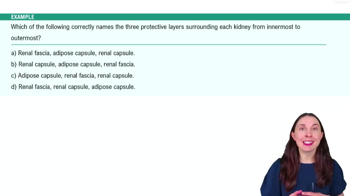
The Kidneys Example 1