Ch. 18 The Cardiovascular System II: The Blood Vessels
Amerman - Human Anatomy & Physiology 2nd Edition
Amerman2nd EditionHuman Anatomy & PhysiologyISBN: 9780136873822Not the one you use?Change textbook
Chapter 18, Problem 1a

Mark the following statements as true or false. If a statement is false, correct it to make a true statement.
Arteries are the exchange vessels of the cardiovascular system.

Verified step by step guidance
1
Step 1: Understand the role of arteries in the cardiovascular system. Arteries are blood vessels that carry blood away from the heart to various parts of the body. They are primarily involved in transporting blood, not in the exchange of substances.
Step 2: Learn about the exchange vessels in the cardiovascular system. The exchange of gases, nutrients, and waste products occurs in capillaries, which are small, thin-walled blood vessels designed for this purpose.
Step 3: Compare the function of arteries and capillaries. Arteries are larger and have thicker walls to withstand high pressure, while capillaries are specialized for exchange due to their thin walls and proximity to tissues.
Step 4: Evaluate the statement provided. The statement 'Arteries are the exchange vessels of the cardiovascular system' is false because arteries are not involved in the exchange process; capillaries are the exchange vessels.
Step 5: Correct the false statement. The corrected statement is: 'Capillaries are the exchange vessels of the cardiovascular system.'

Verified video answer for a similar problem:

This video solution was recommended by our tutors as helpful for the problem above.
Was this helpful?

Key Concepts

Here are the essential concepts you must grasp in order to answer the question correctly.

Arteries

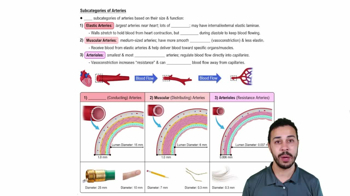
Arteries are blood vessels that carry oxygenated blood away from the heart to the tissues of the body, except for the pulmonary arteries, which carry deoxygenated blood to the lungs. They have thick, elastic walls to withstand high pressure from the heart's pumping action.
Recommended video:
14:43
Subcategories of Arteries

Exchange Vessels

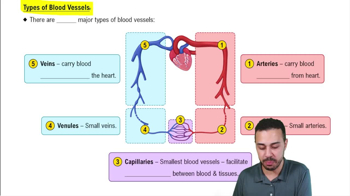
Exchange vessels refer to capillaries, which are the smallest blood vessels in the cardiovascular system. They facilitate the exchange of oxygen, carbon dioxide, nutrients, and waste products between blood and surrounding tissues through their thin walls.
Recommended video:
5:34
Types of Blood Vessels

Cardiovascular System

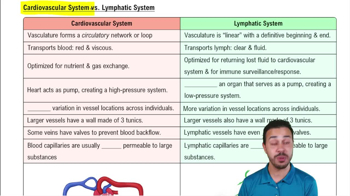
The cardiovascular system consists of the heart, blood vessels, and blood, functioning to transport nutrients, gases, hormones, and waste products throughout the body. It plays a crucial role in maintaining homeostasis and supporting cellular functions.
Recommended video:
6:06
Cardiovascular System vs. Lymphatic System