Ch. 17 The Cardiovascular System I: The Heart
Amerman - Human Anatomy & Physiology 2nd Edition
Amerman2nd EditionHuman Anatomy & PhysiologyISBN: 9780136873822Not the one you use?Change textbook
Chapter 17, Problem 8e

Mark the following statements as true or false. If a statement is false, correct it to make a true statement.
Open sodium ion channels cause hyperpolarization in pacemaker cells, which triggers HCN channels to open and begins a new action potential.

Verified step by step guidance
1
Step 1: Understand the role of sodium ion channels in pacemaker cells. Sodium ion channels typically allow sodium ions (Na⁺) to flow into the cell, leading to depolarization rather than hyperpolarization. Hyperpolarization occurs when the membrane potential becomes more negative, which is usually caused by potassium ion (K⁺) efflux or chloride ion (Cl⁻) influx.
Step 2: Review the function of HCN (hyperpolarization-activated cyclic nucleotide-gated) channels. These channels open in response to hyperpolarization, allowing sodium ions to enter the cell and contribute to the gradual depolarization that initiates a new action potential in pacemaker cells.
Step 3: Analyze the statement provided. The statement claims that open sodium ion channels cause hyperpolarization, which is incorrect. Sodium ion channels cause depolarization, not hyperpolarization.
Step 4: Correct the false statement. A true version of the statement would be: 'Open sodium ion channels cause depolarization in pacemaker cells, which triggers HCN channels to open and begins a new action potential.'
Step 5: Verify the corrected statement by reviewing the physiology of pacemaker cells and their action potential cycle, ensuring the explanation aligns with established scientific understanding.

Verified video answer for a similar problem:

This video solution was recommended by our tutors as helpful for the problem above.
Was this helpful?

Key Concepts

Here are the essential concepts you must grasp in order to answer the question correctly.

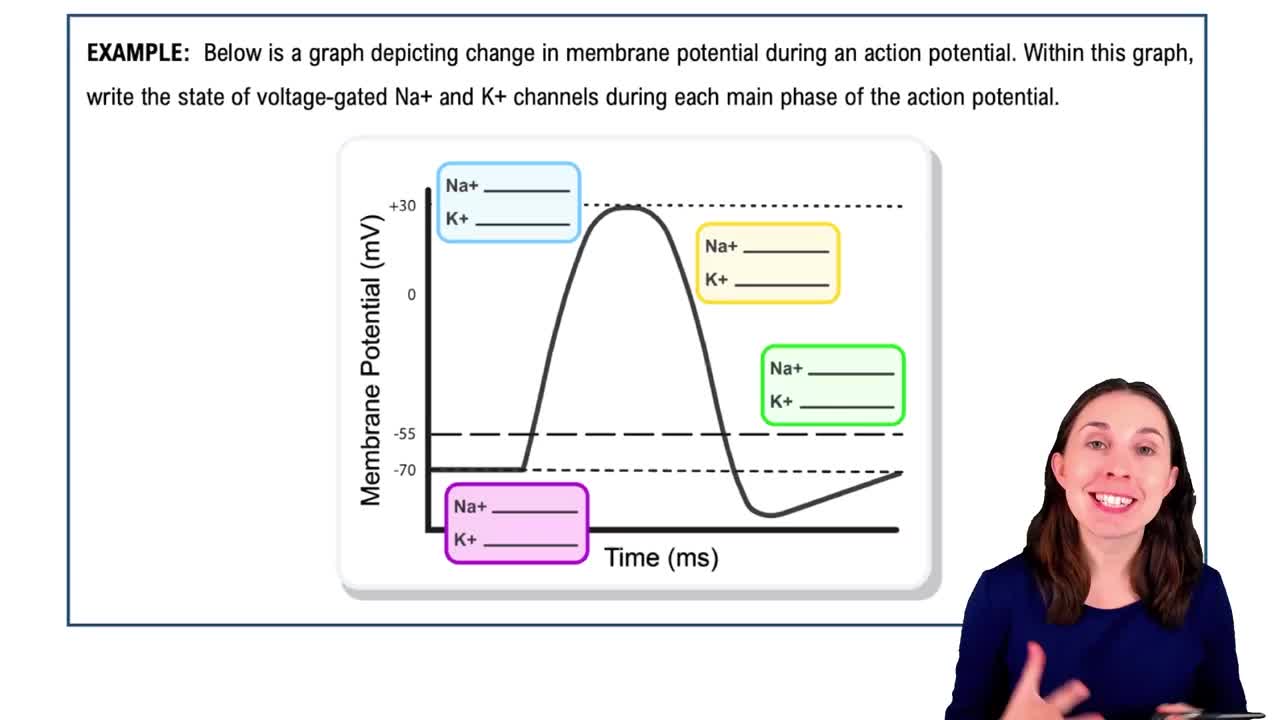
Hyperpolarization

Hyperpolarization refers to an increase in the membrane potential of a cell, making it more negative than the resting potential. In pacemaker cells, this occurs when ion channels, such as sodium channels, open, allowing positive ions to flow out or negative ions to flow in, which can inhibit the generation of action potentials.
Recommended video:
02:36
Action Potentials Example 1

Pacemaker Cells

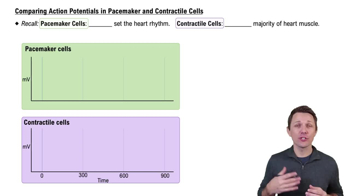
Pacemaker cells are specialized cardiac cells that generate electrical impulses to regulate heart rhythm. They are primarily located in the sinoatrial node and are responsible for initiating the heartbeat by undergoing spontaneous depolarization, which leads to action potentials that trigger heart contractions.
Recommended video:
Guided course
6:36
Comparing Action Potentials in Pacemaker and Contractile Cells

HCN Channels

Hyperpolarization-activated cyclic nucleotide-gated (HCN) channels are ion channels that open in response to hyperpolarization. They play a crucial role in pacemaker activity by allowing sodium ions to enter the cell, contributing to the depolarization phase of the action potential and facilitating the rhythmic firing of pacemaker cells.
Recommended video:
7:24
Anastomoses Form Collateral Channels