
Pearson+ LogoPearson+ Logo
Ch. 17 The Cardiovascular System I: The Heart
Amerman - Human Anatomy & Physiology 2nd Edition
Erin C. Amerman2nd EditionHuman Anatomy & PhysiologyISBN: 9780136873822Not the one you use?Change textbook
Chapter 17, Problem 10

The ______ is the primary pacemaker of the heart.
a. Atrioventricular node
b. sinoatrial node
c. Purkinje fiber system
d. Atrioventricular bundle

Verified step by step guidance
1
Step 1: Understand the role of the pacemaker in the heart. The pacemaker is responsible for initiating and regulating the electrical impulses that control the heartbeat.
Step 2: Review the anatomy of the heart's conduction system. The conduction system includes the sinoatrial (SA) node, atrioventricular (AV) node, atrioventricular bundle, and Purkinje fibers.
Step 3: Learn the specific function of each component. The sinoatrial (SA) node is located in the right atrium and is known as the primary pacemaker because it generates the initial electrical impulse that sets the heart rate. The atrioventricular (AV) node acts as a secondary pacemaker and delays the impulse to allow the ventricles to fill. The atrioventricular bundle and Purkinje fibers help propagate the impulse through the ventricles.
Step 4: Compare the options provided in the question. The sinoatrial (SA) node is the correct answer because it is the primary pacemaker of the heart, while the other components play supporting roles in the conduction system.
Step 5: Confirm your understanding by visualizing the pathway of electrical conduction in the heart, starting from the sinoatrial (SA) node and moving through the atrioventricular (AV) node, atrioventricular bundle, and Purkinje fibers.

Verified video answer for a similar problem:

This video solution was recommended by our tutors as helpful for the problem above.
Was this helpful?

Key Concepts

Here are the essential concepts you must grasp in order to answer the question correctly.

Sinoatrial Node

The sinoatrial (SA) node is a specialized group of cells located in the right atrium of the heart. It is known as the primary pacemaker because it generates electrical impulses that initiate the heartbeat, setting the rhythm for the entire heart. The SA node's activity is influenced by the autonomic nervous system, which adjusts heart rate based on the body's needs.
Recommended video:
5:05
Introduction to Lymph Nodes

Atrioventricular Node

The atrioventricular (AV) node is another critical component of the heart's electrical conduction system, located between the atria and ventricles. It serves as a gatekeeper, receiving impulses from the SA node and delaying them slightly before passing them to the ventricles. This delay allows the atria to contract and fill the ventricles with blood before they contract, ensuring efficient blood flow.
Recommended video:
5:05
Introduction to Lymph Nodes

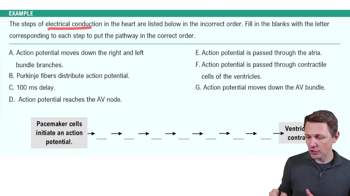
Electrical Conduction System

The electrical conduction system of the heart includes structures such as the SA node, AV node, bundle of His, and Purkinje fibers. This system coordinates the heart's contractions by transmitting electrical signals throughout the heart muscle. Understanding this system is essential for comprehending how the heart maintains a regular rhythm and responds to physiological demands.
Recommended video:
Guided course
3:42
Electrical Conduction System of the Heart Example 2