Ch. 24 The Urinary System
Amerman - Human Anatomy & Physiology 2nd Edition
Amerman2nd EditionHuman Anatomy & PhysiologyISBN: 9780136873822Not the one you use?Change textbook
Chapter 24, Problem 3b

Mark the following statements as true or false. If a statement is false, correct it to make a true statement.
b. Internally, the kidneys consist of an outer renal medulla, a middle renal pelvis, and an inner renal cortex.

Verified step by step guidance
1
Step 1: Begin by identifying the anatomical structure of the kidney. The kidney is divided into three main regions: the outer renal cortex, the middle renal medulla, and the inner renal pelvis.
Step 2: Compare the statement provided in the problem to the correct anatomical structure of the kidney. The statement claims that the kidney consists of an outer renal medulla, a middle renal pelvis, and an inner renal cortex.
Step 3: Analyze the discrepancies in the statement. The outermost layer of the kidney is the renal cortex, not the renal medulla. The renal medulla is located in the middle region, and the renal pelvis is the innermost structure where urine collects before it is transported to the ureter.
Step 4: Mark the statement as false because the order of the kidney's regions is incorrect. The correct order is: outer renal cortex, middle renal medulla, and inner renal pelvis.
Step 5: Correct the statement to make it true: 'Internally, the kidneys consist of an outer renal cortex, a middle renal medulla, and an inner renal pelvis.'

Verified video answer for a similar problem:

This video solution was recommended by our tutors as helpful for the problem above.
Was this helpful?

Key Concepts

Here are the essential concepts you must grasp in order to answer the question correctly.

Kidney Anatomy

The kidneys are vital organs in the urinary system, primarily responsible for filtering blood and producing urine. They consist of three main regions: the outer renal cortex, the inner renal medulla, and the renal pelvis. The renal cortex is the outer layer, while the medulla contains the renal pyramids and is involved in urine concentration. The renal pelvis serves as a funnel for urine to flow into the ureter.
Recommended video:
1:00
The Kidneys Example 1

Renal Cortex vs. Renal Medulla

The renal cortex and renal medulla are distinct regions of the kidney with different functions. The renal cortex is the outer layer that contains nephrons, the functional units of the kidney, responsible for filtering blood. In contrast, the renal medulla, located beneath the cortex, contains structures that help concentrate urine and regulate water balance through the loop of Henle and collecting ducts.
Recommended video:
4:58
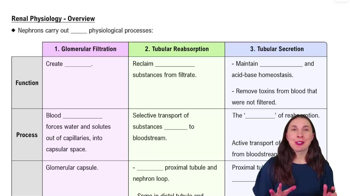
Overview of Renal Physiology

Renal Pelvis

The renal pelvis is the central part of the kidney that collects urine produced by the nephrons before it moves to the ureter. It acts as a reservoir for urine and plays a crucial role in the drainage system of the kidney. Understanding the renal pelvis's function is essential for comprehending how urine is transported from the kidneys to the bladder.
Recommended video:
4:58
Overview of Renal Physiology
Related Practice
Textbook Question

Explain how each of the drugs in question 1 from this section would lower blood pressure.

803
views

Textbook Question

Deana is a 4-year-old girl with a rare genetic defect that causes the Na+/glucose symporters in the proximal tubule to reabsorb fewer glucose and sodium ions than normal. Predict the effects this defect will have on the composition and volume of Deana's urine. Explain why you would expect to see increased activity of the tubuloglomerular feedback and the renin-angiotensin-aldosterone system in Deana's kidneys.

705
views
Textbook Question

Mark the following statements as true or false. If a statement is false, correct it to make a true statement.

d. Filtrate flows from the renal corpuscle to the distal tubule, the nephron loop, the proximal tubule, and into the collecting system.

635
views
Textbook Question

Mark the following statements as true or false. If a statement is false, correct it to make a true statement.

c. The first capillary bed of the kidneys is the peritubular capillaries, which are fed by the afferent arteriole and drained by the efferent arteriole.

816
views
1
rank
Textbook Question

Mark the following statements as true or false. If a statement is false, correct it to make a true statement.

a. The kidneys are retroperitoneal and covered by three layers of connective tissue.

803
views
1
rank
Textbook Question

Cortical and juxtamedullary nephrons differ in the:

a. Lengths of their nephron loops

b. Structure of the capillaries surrounding them

c. Structure of their renal corpuscles

d. Both a and b are correct

e. Both b and c are correct

1519
views
1
rank