Ch. 18 The Cardiovascular System II: The Blood Vessels
Amerman - Human Anatomy & Physiology 2nd Edition
Amerman2nd EditionHuman Anatomy & PhysiologyISBN: 9780136873822Not the one you use?Change textbook
Chapter 18, Problem 5

Which of the following would produce a decrease in blood pressure?
a. Increased cardiac output
b. Vasodilation
c. Vasoconstriction
d. Increased blood volume

Verified step by step guidance
1
Understand the relationship between blood pressure and the factors listed in the options. Blood pressure is influenced by cardiac output, vascular resistance, and blood volume.
Analyze the effect of increased cardiac output (option a). Cardiac output is the amount of blood the heart pumps per minute. Increased cardiac output typically raises blood pressure because more blood is being pushed through the vessels.
Examine the effect of vasodilation (option b). Vasodilation refers to the widening of blood vessels, which decreases vascular resistance. Lower resistance allows blood to flow more easily, leading to a decrease in blood pressure.
Consider the impact of vasoconstriction (option c). Vasoconstriction is the narrowing of blood vessels, which increases vascular resistance. Higher resistance makes it harder for blood to flow, leading to an increase in blood pressure.
Evaluate the effect of increased blood volume (option d). Blood volume is the total amount of blood circulating in the body. An increase in blood volume raises blood pressure because there is more fluid exerting pressure on the vessel walls.

Verified video answer for a similar problem:

This video solution was recommended by our tutors as helpful for the problem above.
Was this helpful?

Key Concepts

Here are the essential concepts you must grasp in order to answer the question correctly.

Blood Pressure Regulation

Blood pressure is regulated by the balance between cardiac output and vascular resistance. Cardiac output refers to the volume of blood the heart pumps per minute, while vascular resistance is influenced by the diameter of blood vessels. Understanding how these factors interact is crucial for determining what influences blood pressure.
Recommended video:
Guided course
6:12
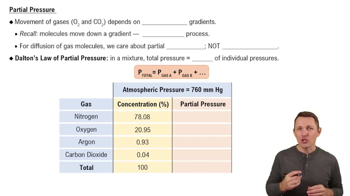
Partial Pressure

Vasodilation

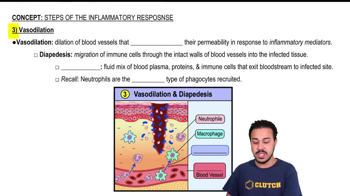
Vasodilation is the process by which blood vessels widen, leading to a decrease in vascular resistance. This widening allows for increased blood flow and can result in lower blood pressure. It is often triggered by various factors, including the release of certain hormones and neurotransmitters.
Recommended video:
2:39
Step 3: Vasodilation

Vasoconstriction

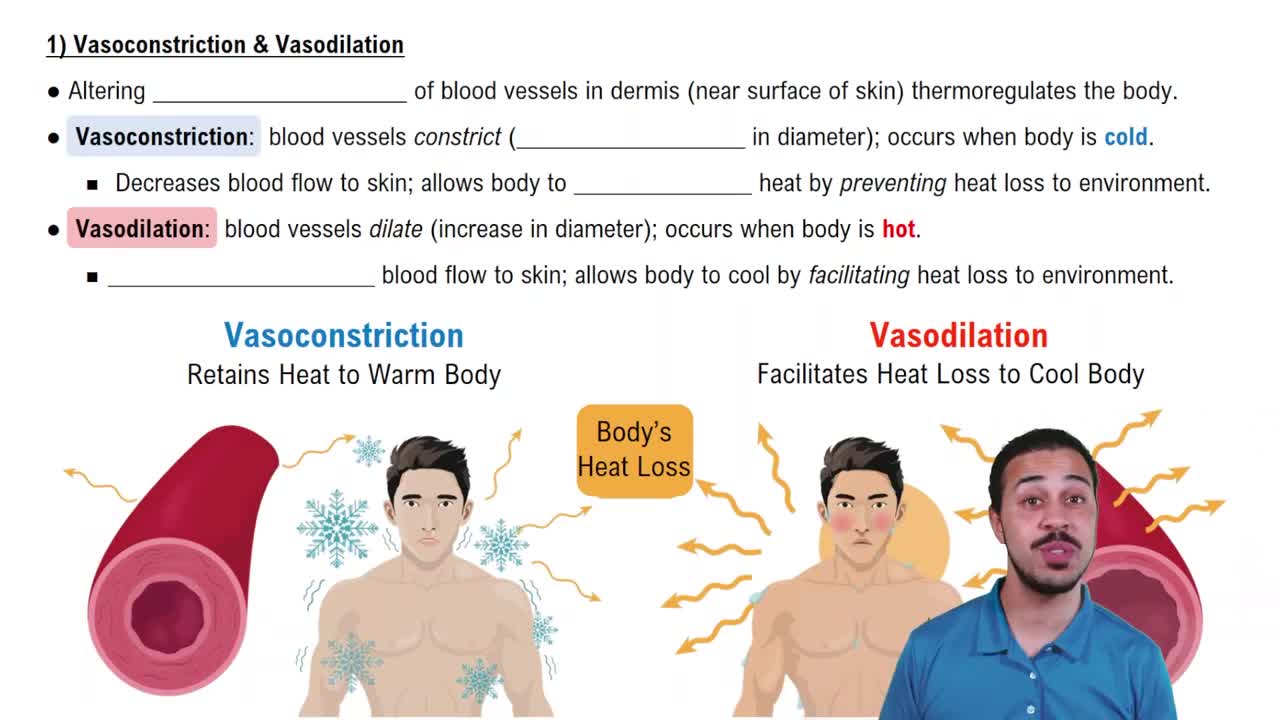
Vasoconstriction is the narrowing of blood vessels, which increases vascular resistance and can lead to an increase in blood pressure. This process is typically mediated by the contraction of smooth muscle in the vessel walls and is influenced by factors such as stress, cold temperatures, and certain hormones.
Recommended video:
05:07
Vasoconstriction & Vasodilation
Related Practice
Textbook Question

The lowest pressure in the systemic circuit occurs in the:

a. Arteries

b. Arterioles

c. Capillaries

d. Venules

e. Veins

940
views

Textbook Question

The two pressures within the systemic arterial circuit are the_____ pressure and _____ pressure. The difference between these two pressures is the_____ pressure.

771
views
Textbook Question

Explain the mechanisms that assist in the return of venous blood to the heart.

1416
views
Textbook Question

Which of the following factors would increase peripheral resistance?

a. Increased blood viscosity

b. Shorter vessel

c. Vasodilation

d. An increase in vessel radius

1097
views
Textbook Question

Fill in the blanks: The coronary arteries are the first branches off the ________. The right coronary artery becomes the ________ on the posterior side of the heart. The left coronary artery branches into the ________ and the ________.

1222
views
1
rank
Textbook Question

Match the following terms with the correct definition.

____ Auricle      

____ Aorta      

____ Coronary sinus       

____ Papillary muscle      

____ Fossa ovalis     

____ Pectinate muscle      

____ Venae cavae      

____ Pulmonary trunk      

____ Chordae tendineae      

____ Pulmonary veins 

a. Drainage point for the coronary veins

b. Extensions that attach papillary muscles to valves

c. Remnant of a hole present in the fetal interatrial septum

d. Two largest veins of the systemic circuit

e. Flaplike extension from the right or left atrium

f. Finger-like projections of ventricular muscle

g. Main artery of the pulmonary circuit

h. Veins that drain the pulmonary circuit

i. Largest artery of the systemic circuit

j. Ridges of muscle in the atria

677
views