
Textbook Question
The lowest pressure in the systemic circuit occurs in the:
a. Arteries
b. Arterioles
c. Capillaries
d. Venules
e. Veins
940
views

 Verified step by step guidance
 6:12
6:12
 2:39
2:39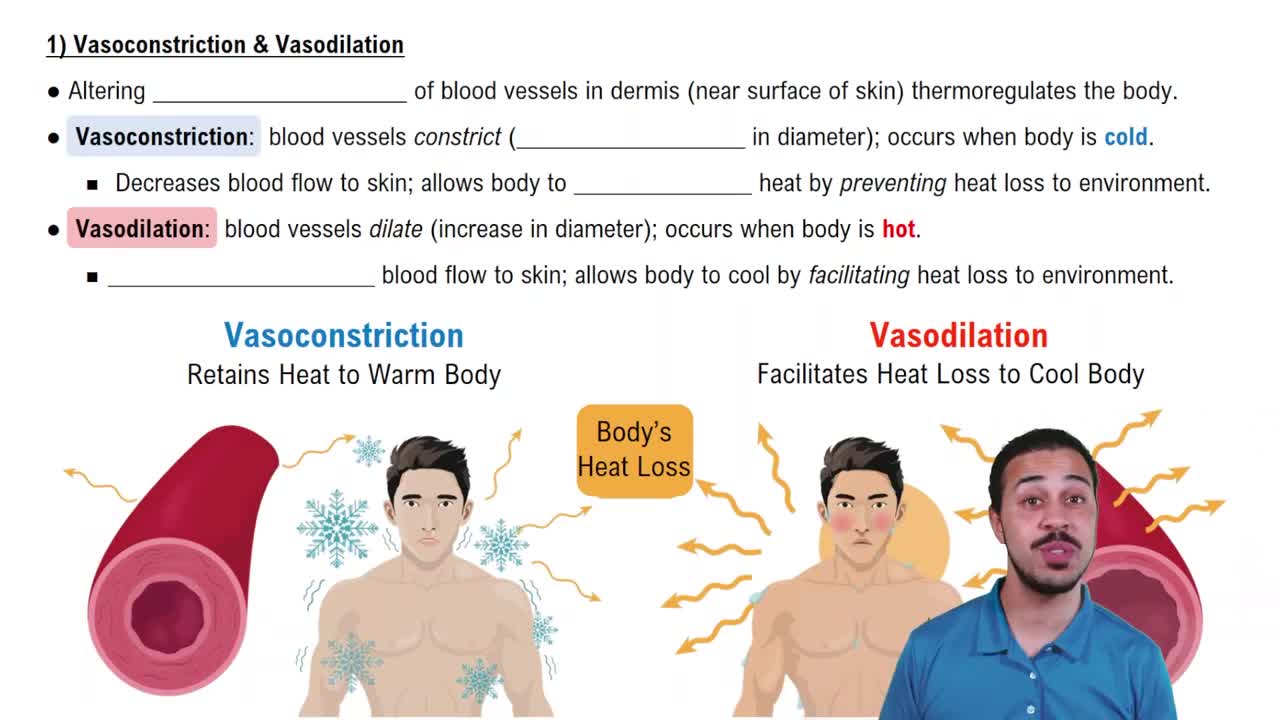 05:07
05:07The lowest pressure in the systemic circuit occurs in the:
a. Arteries
b. Arterioles
c. Capillaries
d. Venules
e. Veins
The two pressures within the systemic arterial circuit are the_____ pressure and _____ pressure. The difference between these two pressures is the_____ pressure.
Explain the mechanisms that assist in the return of venous blood to the heart.
Which of the following factors would increase peripheral resistance?
a. Increased blood viscosity
b. Shorter vessel
c. Vasodilation
d. An increase in vessel radius
Fill in the blanks: The coronary arteries are the first branches off the ________. The right coronary artery becomes the ________ on the posterior side of the heart. The left coronary artery branches into the ________ and the ________.
Match the following terms with the correct definition.
____ Auricle
____ Aorta
____ Coronary sinus
____ Papillary muscle
____ Fossa ovalis
____ Pectinate muscle
____ Venae cavae
____ Pulmonary trunk
____ Chordae tendineae
____ Pulmonary veins
a. Drainage point for the coronary veins
b. Extensions that attach papillary muscles to valves
c. Remnant of a hole present in the fetal interatrial septum
d. Two largest veins of the systemic circuit
e. Flaplike extension from the right or left atrium
f. Finger-like projections of ventricular muscle
g. Main artery of the pulmonary circuit
h. Veins that drain the pulmonary circuit
i. Largest artery of the systemic circuit
j. Ridges of muscle in the atria