Ch. 13 The Peripheral Nervous System and Reflex Activity
Hoehn - Marieb Human Anatomy & Physiology, 12th edition
Hoehn, Haynes, Abbott12th EditionMarieb Human Anatomy & PhysiologyISBN: 9780138242732Not the one you use?Change textbook
Chapter 13, Problem 11

List the structural components of the peripheral nervous system, and describe the function of each component.

Verified step by step guidance
1
Identify the main structural components of the peripheral nervous system (PNS), which include cranial nerves, spinal nerves, ganglia, and sensory receptors.
Describe cranial nerves as nerves that emerge directly from the brain and primarily serve the head and neck region, facilitating sensory and motor functions.
Explain spinal nerves as nerves that emerge from the spinal cord, responsible for transmitting sensory information to the central nervous system (CNS) and carrying motor commands to muscles and glands.
Define ganglia as clusters of neuron cell bodies located outside the CNS that act as relay points and processing centers for nerve signals within the PNS.
Describe sensory receptors as specialized structures that detect changes in the environment (stimuli) and convert them into nerve impulses to be sent to the CNS for processing.

Key Concepts

Here are the essential concepts you must grasp in order to answer the question correctly.

Peripheral Nervous System (PNS) Overview

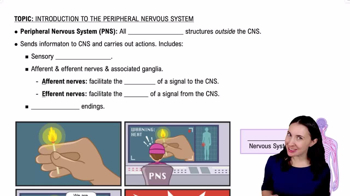
The peripheral nervous system consists of all nerves and ganglia outside the brain and spinal cord. It connects the central nervous system to limbs and organs, facilitating communication between the body and brain.
Recommended video:
3:33
Peripheral Nervous System

Structural Components of the PNS

The main structural components of the PNS include cranial nerves, spinal nerves, ganglia, and sensory receptors. Cranial and spinal nerves transmit signals, ganglia contain neuron cell bodies, and sensory receptors detect stimuli.
Recommended video:
Guided course
5:04
Optic Components

Functions of PNS Components

Each PNS component has specific roles: cranial and spinal nerves carry motor and sensory information; ganglia process signals locally; sensory receptors detect environmental changes, enabling reflexes and voluntary responses.
Recommended video:
Guided course
5:04
Optic Components