Ch. 18 The Cardiovascular System: The Heart
Hoehn - Marieb Human Anatomy & Physiology, 12th edition
Hoehn, Haynes, Abbott12th EditionMarieb Human Anatomy & PhysiologyISBN: 9780138242732Not the one you use?Change textbook
Chapter 18, Problem 5

Select the anatomical or physiological feature that correctly describes cardiac muscle and not skeletal muscle.
(a) striations appear as alternating light and dark bands,
(b) intercalated discs connect adjacent muscle cells,
(c) sarcoplasmic reticulum stores and releases calcium ions,
(d) calcium ions bind troponin to signal contraction

Verified step by step guidance
1
Step 1: Understand the characteristics of skeletal muscle. Skeletal muscle is striated, meaning it has alternating light and dark bands visible under a microscope, and it uses calcium ions binding to troponin to initiate contraction. It also has a sarcoplasmic reticulum that stores and releases calcium ions.
Step 2: Understand the characteristics of cardiac muscle. Cardiac muscle is also striated, so it shares the feature of alternating light and dark bands with skeletal muscle. It also has a sarcoplasmic reticulum and uses calcium ions binding to troponin for contraction.
Step 3: Identify the unique feature of cardiac muscle that is not present in skeletal muscle. Cardiac muscle cells are connected by specialized junctions called intercalated discs, which allow for synchronized contraction and electrical coupling between cells.
Step 4: Compare each option to these features: (a) striations are common to both muscle types, (b) intercalated discs are unique to cardiac muscle, (c) sarcoplasmic reticulum function is common to both, (d) calcium binding to troponin is common to both.
Step 5: Conclude that the correct answer is the feature unique to cardiac muscle, which is the presence of intercalated discs connecting adjacent muscle cells.

Verified video answer for a similar problem:

This video solution was recommended by our tutors as helpful for the problem above.
Video duration:
1m
Was this helpful?

Key Concepts

Here are the essential concepts you must grasp in order to answer the question correctly.

Cardiac Muscle Structure

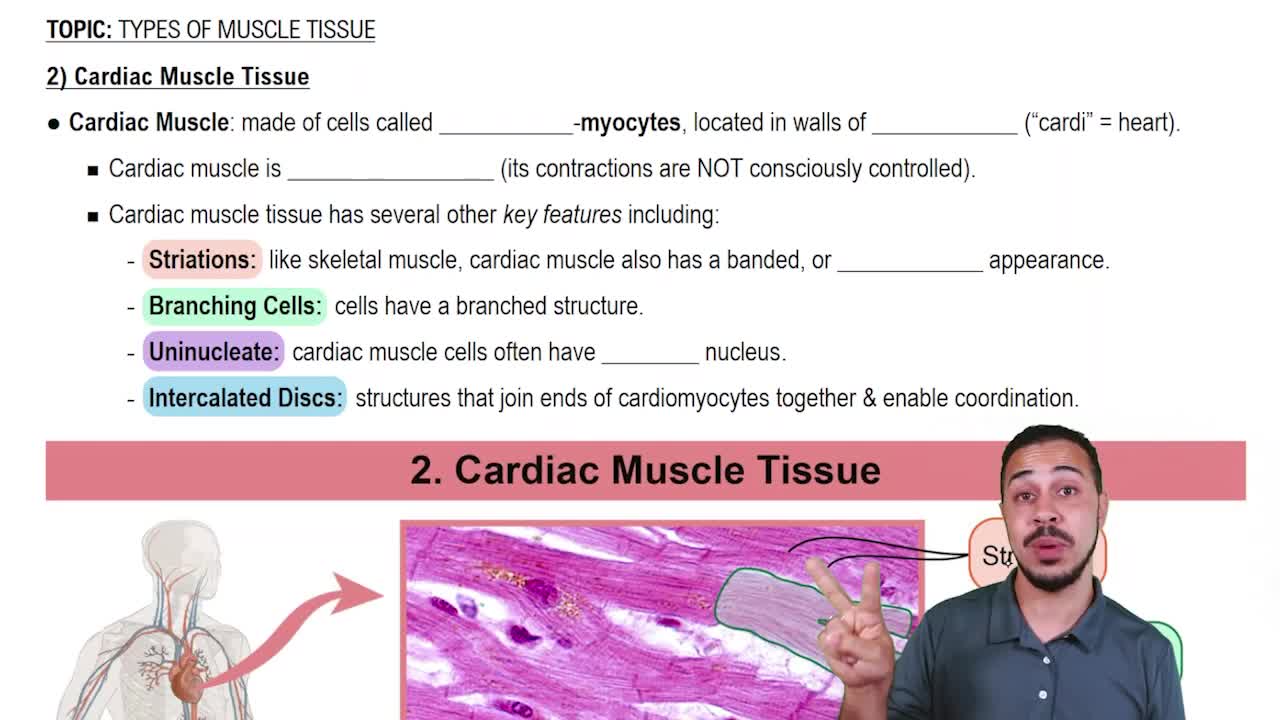
Cardiac muscle cells are striated like skeletal muscle but are uniquely connected by intercalated discs. These discs contain gap junctions and desmosomes, allowing synchronized contraction and mechanical stability, which is essential for heart function.
Recommended video:
Guided course
06:00
Cardiac Muscle Tissue

Intercalated Discs

Intercalated discs are specialized connections between cardiac muscle cells that facilitate electrical and mechanical coupling. They enable rapid transmission of action potentials, ensuring the heart contracts as a coordinated unit, a feature absent in skeletal muscle.
Recommended video:
Guided course
6:01
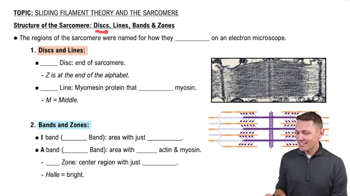
Structure of the Sarcomere: Bands, Zones, Discs & Lines

Calcium's Role in Muscle Contraction

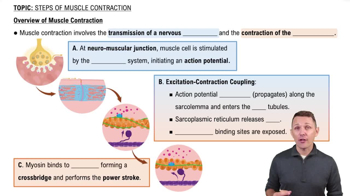
In both cardiac and skeletal muscle, calcium ions bind to troponin to initiate contraction. However, cardiac muscle relies on calcium-induced calcium release from the sarcoplasmic reticulum, while skeletal muscle primarily depends on direct release triggered by nerve signals.
Recommended video:
Guided course
4:53
Overview of Muscle Contraction