Pearson+ LogoPearson+ Logo
Ch. 1 Introduction to Anatomy and Physiology
Amerman - Human Anatomy & Physiology 2nd Edition
Erin C. Amerman2nd EditionHuman Anatomy & PhysiologyISBN: 9780136873822Not the one you use?Change textbook
Chapter 1, Problem 17

A gradient exists:
a. When heat is concentrated in one area of the body
b. When more of a substance is located in one place than in another
c. When there is higher pressure in one place than in another
d. All of the above are correct
e. None of the above are correct

Verified step by step guidance
1
Step 1: Understand the concept of a gradient. In Anatomy & Physiology, a gradient refers to a difference in a particular property (e.g., concentration, pressure, temperature) between two regions. This difference drives movement or flow from one area to another, typically from high to low values.
Step 2: Analyze option (a): 'When heat is concentrated in one area of the body.' This describes a temperature gradient, where heat moves from a region of higher temperature to a region of lower temperature. Determine if this aligns with the definition of a gradient.
Step 3: Analyze option (b): 'When more of a substance is located in one place than in another.' This describes a concentration gradient, where substances like ions or molecules move from areas of higher concentration to areas of lower concentration. Check if this fits the definition of a gradient.
Step 4: Analyze option (c): 'When there is higher pressure in one place than in another.' This describes a pressure gradient, where fluids or gases move from areas of higher pressure to areas of lower pressure. Confirm if this matches the concept of a gradient.
Step 5: Evaluate option (d): 'All of the above are correct.' If all the previous options (a, b, and c) align with the definition of a gradient, then this option would be correct. Option (e) can be ruled out if all the above are indeed correct.

Verified video answer for a similar problem:

This video solution was recommended by our tutors as helpful for the problem above.
Was this helpful?

Key Concepts

Here are the essential concepts you must grasp in order to answer the question correctly.

Gradient

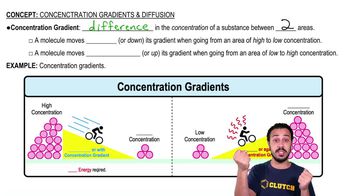
A gradient refers to a difference in a particular property, such as temperature, concentration, or pressure, between two areas. This difference creates a potential for movement or change, as substances tend to move from areas of higher concentration or pressure to areas of lower concentration or pressure, seeking equilibrium.
Recommended video:
04:51
Concentration Gradients and Diffusion

Heat Concentration

Heat concentration occurs when thermal energy is unevenly distributed within a system, leading to areas of higher temperature. This can create a thermal gradient, which drives heat transfer from the hotter area to cooler areas, influencing various physiological processes in the body.
Recommended video:
04:51
Concentration Gradients and Diffusion

Pressure Gradient

A pressure gradient exists when there is a difference in pressure between two regions. This gradient can cause fluids or gases to flow from areas of higher pressure to areas of lower pressure, which is fundamental in various biological and physical processes, including respiration and blood circulation.
Recommended video:
04:51
Concentration Gradients and Diffusion