Pearson+ LogoPearson+ Logo
Ch. 3 The Cell
Amerman - Human Anatomy & Physiology 2nd Edition
Erin C. Amerman2nd EditionHuman Anatomy & PhysiologyISBN: 9780136873822Not the one you use?Change textbook
Chapter 3, Problem 19a

Mark the following statements about the cell cycle as true or false. If a statement is false, correct it to make a true statement.
During the S phase of the cell cycle, the cell stalls until conditions for division are more favorable

Verified step by step guidance
1
Understand the cell cycle phases: The cell cycle consists of interphase (G1, S, and G2 phases) and the mitotic phase (M phase). The S phase is specifically responsible for DNA replication, not stalling for favorable conditions.
Analyze the statement: The statement claims that during the S phase, the cell stalls until conditions for division are more favorable. This is incorrect because the S phase is dedicated to DNA synthesis and replication, not stalling.
Correct the false statement: The corrected statement should be: 'During the S phase of the cell cycle, the cell replicates its DNA in preparation for cell division.'
Review the purpose of stalling in the cell cycle: Stalling typically occurs at checkpoints, such as the G1 checkpoint or G2 checkpoint, where the cell ensures conditions are favorable for division and checks for DNA damage.
Conclude the correction: The S phase is an active phase of DNA replication, and stalling for favorable conditions does not occur during this phase. Ensure understanding of the distinction between checkpoints and specific phases of the cell cycle.

Verified video answer for a similar problem:

This video solution was recommended by our tutors as helpful for the problem above.
Was this helpful?

Key Concepts

Here are the essential concepts you must grasp in order to answer the question correctly.

Cell Cycle Stages

The cell cycle consists of several stages, including G1, S, G2, and M phases. Each phase has specific functions, with the S phase being crucial for DNA replication. Understanding these stages helps clarify the processes that prepare a cell for division.
Recommended video:
03:31
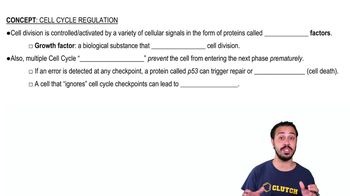
Cell Cycle Regulation

S Phase Function

The S phase, or synthesis phase, is when a cell replicates its DNA, ensuring that each daughter cell receives an identical set of chromosomes. This phase is characterized by active DNA synthesis, not stalling, which is a common misconception.
Recommended video:
03:21
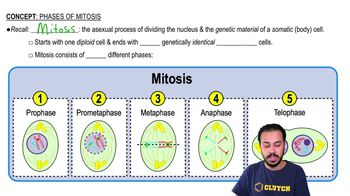
Phases of Mitosis

Cell Cycle Regulation

The cell cycle is tightly regulated by various checkpoints and proteins that ensure conditions are suitable for progression. If conditions are unfavorable, the cell may enter a resting state (G0) rather than stalling in the S phase, highlighting the importance of regulation in cell division.
Recommended video:
03:31
Cell Cycle Regulation
Related Practice
Textbook Question

Number the following steps of protein synthesis in the order in which they occur, starting with 1 and ending with 9.

a. _____The stop codon is reached, and the polypeptide is released. 

b. _____The small ribosomal subunit finds the start codon, and the large ribosomal subunit joins. 

c. _____The end of the gene is reached, and the pre-mRNA is released and then edited. 

d. _____The transcription factor binds the promoter. 

e. _____The protein is folded and modified to become functional. 

f. _____ RNA polymerase builds the mRNA transcript. 

g. _____mRNA and initiator tRNA bind the small ribosomal subunit. 

h. _____ New tRNAs are brought into the A site successively, and the peptide chain of the tRNA in the P site is joined to the amino acid of the tRNA in the A site.

i. ______mRNA exits the nucleus via a nuclear pore.

674
views
Textbook Question

Which of the following is not a phase of mitosis?

a. Interphase

b. Prophase

c. Anaphase

d. Metaphase

568
views
Textbook Question

Why is regulation of the cell cycle necessary?

655
views
Textbook Question

Mark the following statements about the cell cycle as true or false. If a statement is false, correct it to make a true statement.

During metaphase, the sister chromatids are pulled apart and the chromosomes move to the opposite poles of the cell.

546
views
Textbook Question

Mark the following statements about the cell cycle as true or false. If a statement is false, correct it to make a true statement.

The main enzyme that builds the new DNA strands during DNA synthesis is RNA synthetase.

534
views
Textbook Question

Mark the following statements about the cell cycle as true or false. If a statement is false, correct it to make a true statement.

The first three stages of the cell cycle are collectively called interphase.

604
views