Pearson+ LogoPearson+ Logo
Ch. 6 Bones and Bone Tissue
Amerman - Human Anatomy & Physiology 2nd Edition
Erin C. Amerman2nd EditionHuman Anatomy & PhysiologyISBN: 9780136873822Not the one you use?Change textbook
Chapter 6, Problem L2.2

Explain how abnormal bone structure could affect muscle function.

Verified step by step guidance
1
Understand the relationship between bones and muscles: Bones provide the structural framework of the body, while muscles attach to bones via tendons to facilitate movement. Abnormal bone structure can disrupt this relationship, affecting muscle function.
Identify types of abnormal bone structures: Examples include bone deformities (e.g., scoliosis, kyphosis), fractures, or conditions like osteoporosis. These abnormalities can alter the alignment or integrity of bones, impacting how muscles attach and function.
Consider mechanical implications: Abnormal bone structure can change the leverage and angles at which muscles act on bones. For instance, a misaligned joint may reduce the efficiency of muscle contractions, leading to decreased strength or range of motion.
Evaluate the impact on muscle attachment: Abnormal bone structure may affect the points of origin and insertion of muscles. This can lead to altered muscle tension, strain, or even improper functioning of the muscle groups involved.
Assess secondary effects: Chronic abnormal bone structure can lead to compensatory muscle adaptations, such as overuse or underuse of certain muscles. This may result in muscle imbalances, pain, or reduced overall mobility.

Verified video answer for a similar problem:

This video solution was recommended by our tutors as helpful for the problem above.
Was this helpful?

Key Concepts

Here are the essential concepts you must grasp in order to answer the question correctly.

Bone Structure

Bone structure refers to the physical composition and arrangement of bones in the body, which includes their shape, density, and integrity. Abnormalities in bone structure, such as deformities or fractures, can lead to misalignment and altered biomechanics, impacting how muscles interact with the skeletal system.
Recommended video:
Guided course
3:22
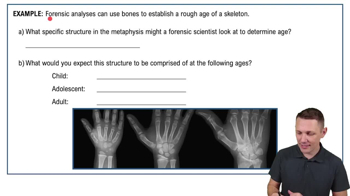
Gross Anatomy of Bones - Structure of a Long Bone Example 1

Muscle Function

Muscle function involves the ability of muscles to contract and produce movement, which is influenced by their attachment to bones. If the bone structure is abnormal, it can change the leverage and range of motion of muscles, potentially leading to decreased strength, coordination, and overall movement efficiency.
Recommended video:
06:04
Functional Groups

Biomechanics

Biomechanics is the study of the mechanical laws relating to the movement or structure of living organisms. It examines how forces interact with the body, including how abnormal bone structures can alter the forces acting on muscles, leading to compensatory movements or increased risk of injury.
Related Practice
Textbook Question

Explain why young men who take anabolic steroids (which mimic the actions of testosterone) often display stunted growth and have an overall shorter stature.

566
views
Textbook Question

Lucy Dupre is a 2-year-old girl living in northern Canada. You notice that her growth seems abnormally slow and she has exhibited signs of weakened bones, including fractures. Her parents admit they have not supplemented her diet with vitamin D, as they feel that any supplementation is 'unnatural' and 'not organic.' Explain why Lucy is having problems with her bones and bone growth.

414
views
Textbook Question

Fouz Akkad is a 6-year-old girl who has been diagnosed with a rare genetic defect in which her lysosomes are unable to maintain an acidic pH. What are lysosomes? Why do lysosomes require an acidic pH? How will this affect the ability of certain bone cells to function? What consequences will this disease have on Fouz's bones?

434
views
Textbook Question

Match the following terms with the correct definition.

____Long bone    

____Epiphysis    

____Nutrient artery    

____Flat bone    

____Short bone    

____Periosteum    

____Diaphysis    

____Medullary cavitya.

a. Main source of blood to the medullary cavity

b. Membrane surrounding the bone

c. Bone that is about as wide as it is long

d. Shaft of a long bone

e. Bone that is longer than it is wide

f. Canal running down the center of the diaphysis

g. End of a long bone

h. Bone that is broad and thin

534
views
Textbook Question

Explain the differences between red bone marrow and yellow bone marrow.

914
views
1
rank
Textbook Question

Mark the following statements about bone tissue as true or false. If a statement is false, correct it to make a true statement.

a. The primary mineral in the inorganic matrix is hydroxyapatite.

418
views