Pearson+ LogoPearson+ Logo
Ch. 7 The Skeleton
Marieb - Human Anatomy & Physiology 7th Edition
Elaine N. Marieb, Katja Hoehn7th EditionHuman Anatomy & PhysiologyISBN: 9780805359091Not the one you use?Change textbook
Chapter 7, Problem 1

Match the bones in column B with their description in column A. (Note that some descriptions require more than a single choice.)
Column A
_____ (1) connected by the coronal suture
_____ (2) keystone bone of cranium
_____ (3) keystone bone of the face
_____ (4) form the hard palate
_____ (5) allows the spinal cord to pass
_____ (6) forms the chin
_____  (7) contain paranasal sinuses
_____  (8) contains mastoid sinuses
Column B
a. ethmoid
b. frontal
c. mandible
d. maxillary
e. occipital
f. palatine
g. parietal
h. sphenoid
i. temporal

Verified step by step guidance
1
Step 1: Understand the anatomical locations and functions of the bones listed in Column B. For example, the frontal bone is located at the front of the skull, the parietal bones are on the sides and top, and the occipital bone is at the back of the skull.
Step 2: Match the description of bones connected by the coronal suture. The coronal suture connects the frontal bone with the parietal bones, so identify these bones accordingly.
Step 3: Identify the 'keystone' bones. The keystone bone of the cranium is the sphenoid bone because it articulates with many other cranial bones. The keystone bone of the face is the maxillary bone as it connects with several facial bones.
Step 4: For the hard palate, recognize that it is formed by the maxillary and palatine bones. The hard palate is the bony roof of the mouth.
Step 5: Identify the bone that allows the spinal cord to pass through, which is the occipital bone via the foramen magnum. The chin is formed by the mandible. Paranasal sinuses are found in the frontal, ethmoid, sphenoid, and maxillary bones, while mastoid sinuses are located in the temporal bone.

Verified video answer for a similar problem:

This video solution was recommended by our tutors as helpful for the problem above.
Video duration:
2m
Was this helpful?

Key Concepts

Here are the essential concepts you must grasp in order to answer the question correctly.

Cranial Sutures and Bone Connections

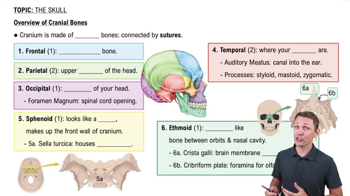
Cranial sutures are immovable joints connecting skull bones. The coronal suture specifically joins the frontal bone to the two parietal bones. Understanding these sutures helps identify which bones are adjacent and connected, crucial for matching bones to their anatomical descriptions.
Recommended video:
Guided course
8:20
Overview of Cranial Bones

Keystone Bones of the Cranium and Face

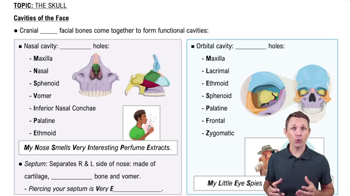
Keystone bones serve as central structural elements. The sphenoid is the keystone of the cranium, connecting multiple cranial bones, while the maxilla is the keystone of the face, supporting facial structure. Recognizing these bones aids in identifying their unique roles and locations.
Recommended video:
Guided course
6:30
Cavities of the Face

Anatomical Features and Functions of Specific Bones

Certain bones have distinctive features: the occipital bone has the foramen magnum for spinal cord passage; the mandible forms the chin; palatine and maxillary bones form the hard palate; temporal bones contain mastoid sinuses; and ethmoid and maxillary bones contain paranasal sinuses. Knowing these features is essential for accurate matching.
Recommended video:
06:04
Functional Groups