Ch. 9 Muscles and Muscle Tissue
Chapter 9, Problem 10

The neurotransmitter released by somatic motor neurons is:
a. Acetylcholine
b. Acetylcholinesterase
c. Norepinephrine

Verified step by step guidance
1
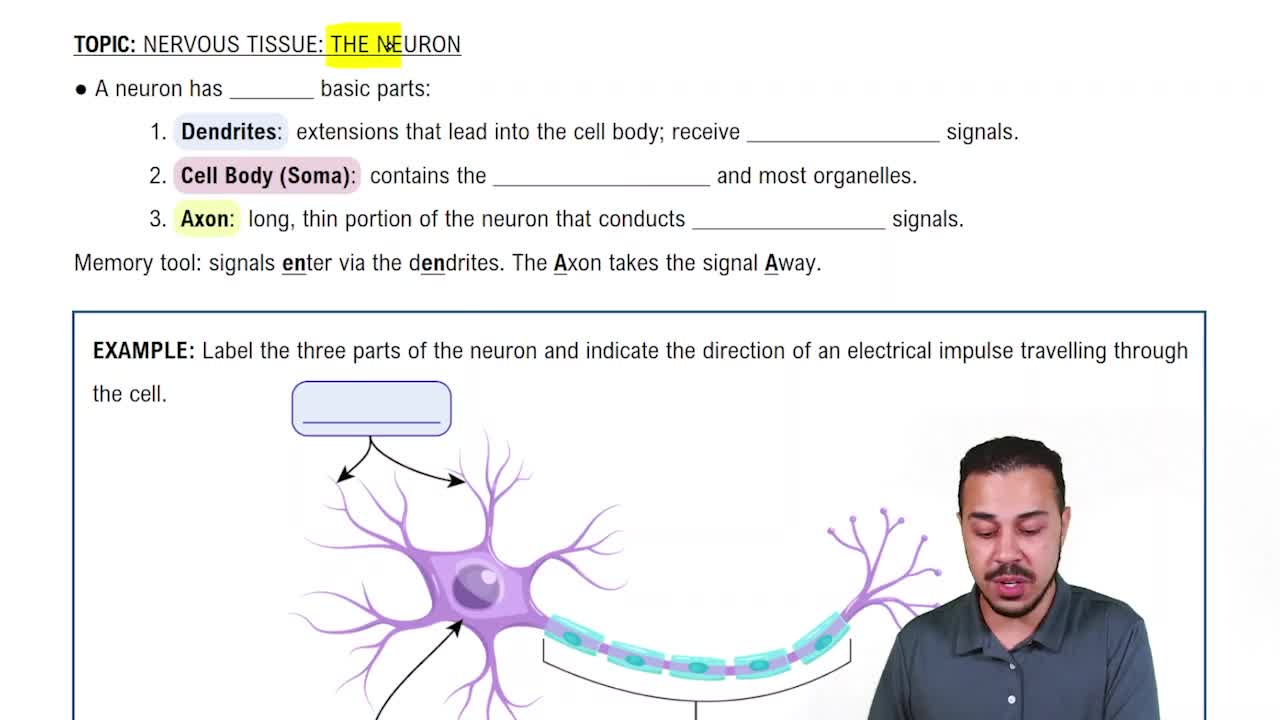
Understand the role of somatic motor neurons: These neurons control voluntary muscle movements by transmitting signals to skeletal muscles.
Recall the neurotransmitters involved in the nervous system: Acetylcholine (ACh) is commonly associated with muscle activation, while norepinephrine is more related to the autonomic nervous system.
Identify the neurotransmitter released at the neuromuscular junction by somatic motor neurons, which is responsible for stimulating skeletal muscle contraction.
Differentiate between acetylcholine and acetylcholinesterase: acetylcholine is the neurotransmitter, whereas acetylcholinesterase is the enzyme that breaks down acetylcholine after its action.
Conclude that the neurotransmitter released by somatic motor neurons is acetylcholine.

Verified video answer for a similar problem:

This video solution was recommended by our tutors as helpful for the problem above.
Video duration:
2m
Was this helpful?

Key Concepts

Here are the essential concepts you must grasp in order to answer the question correctly.

Somatic Motor Neurons

Somatic motor neurons are nerve cells that control voluntary muscle movements by transmitting signals from the central nervous system to skeletal muscles. They play a key role in conscious motor control and reflexes.
Recommended video:

Neurotransmitters

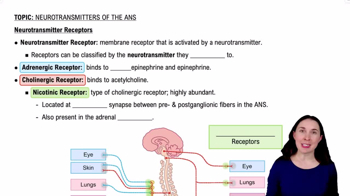
Neurotransmitters are chemical messengers that transmit signals across synapses from neurons to target cells. Different neurotransmitters have specific roles; for example, acetylcholine is commonly involved in muscle activation.
Recommended video:
2:30
Neurotransmitter Receptors

Acetylcholine and Acetylcholinesterase

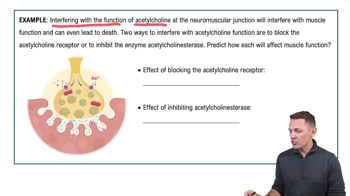
Acetylcholine is the primary neurotransmitter released by somatic motor neurons to stimulate muscle contraction. Acetylcholinesterase is an enzyme that breaks down acetylcholine in the synaptic cleft, terminating the signal and allowing muscle relaxation.
Recommended video:
Guided course
3:26
Steps of Muscle Contraction Example 3
Related Practice
Textbook Question

A smooth, sustained contraction resulting from very rapid stimulation of the muscle, in which no evidence of relaxation is seen, is called:

a. A twitch

b. Temporal summation

c. Multiple motor unit summation

d. Fused tetanus

886
views
2
rank
Textbook Question

Characteristics of isometric contractions include all but:

a. Shortening

b. Increased muscle tension throughout the contraction phase

c. Absence of shortening

d. Used in resistance training

832
views
1
rank
Textbook Question

During muscle contraction, ATP is provided by:

a. a coupled reaction of creatine phosphate with ADP

b. aerobic respiration of glucose, and

c. anaerobic glycolysis.

______ (1) Which provides ATP fastest?

______  (2) Which does (do) not require that oxygen be available?

______  (3) Which provides the highest yield of ATP per glucose molecule?

______  (4) Which results in the formation of lactic acid?

______  (5) Which has carbon dioxide and water products?

______  (6) Which is most important in endurance sports?

1129
views
2
rank
Textbook Question

The ions that enter the skeletal muscle cell during the generation of an action potential are

a. Calcium ions

b. Chloride ions

c. Sodium ions

d. Potassium ions

854
views
1
rank
Textbook Question

Myoglobin has a special function in muscle tissue. It:

a. Breaks down glycogen

b. Is a contractile protein

c. Holds a reserve supply of oxygen in the muscle

739
views
1
rank
Textbook Question

Aerobic exercise results in all of the following except:

a. More capillaries surrounding muscle fibers

b. More mitochondria in muscle cells

c. Increased size and strength of existing muscle cells

d. More myoglobin

1133
views
1
rank