
Pearson+ LogoPearson+ Logo
Ch. 10 - Photosynthesis
Campbell - Campbell Biology 11th Edition
Urry11th EditionCampbell BiologyISBN: 9789357423311Not the one you use?Change textbook
Chapter 10, Problem 6

In mechanism, photophosphorylation is most similar to
a. Substrate-level phosphorylation in glycolysis.
b. Oxidative phosphorylation in cellular respiration.
c. Carbon fixation.
d. Reduction of NADP+.

Verified step by step guidance
1
Understand the concept of photophosphorylation: Photophosphorylation is the process by which ATP is formed using the energy of sunlight during photosynthesis. It occurs in the chloroplasts of plant cells.
Compare photophosphorylation with substrate-level phosphorylation: Substrate-level phosphorylation occurs in glycolysis and involves the direct transfer of a phosphate group to ADP from a phosphorylated intermediate. This process does not involve an electron transport chain.
Compare photophosphorylation with oxidative phosphorylation: Oxidative phosphorylation occurs in cellular respiration within the mitochondria. It involves the electron transport chain and chemiosmosis, where ATP is synthesized using energy derived from the transfer of electrons through a series of complexes.
Consider the role of carbon fixation: Carbon fixation is part of the Calvin cycle in photosynthesis, where CO2 is converted into organic molecules. It does not directly involve the formation of ATP through an electron transport chain.
Evaluate the reduction of NADP+: The reduction of NADP+ to NADPH occurs during the light reactions of photosynthesis, but it is not directly involved in the phosphorylation of ADP to ATP.

Verified video answer for a similar problem:

This video solution was recommended by our tutors as helpful for the problem above.
Video duration:
49s
Was this helpful?

Key Concepts

Here are the essential concepts you must grasp in order to answer the question correctly.

Photophosphorylation

Photophosphorylation is the process by which ATP is formed using the energy of sunlight during photosynthesis. It occurs in the chloroplasts of plant cells, where light energy is captured by chlorophyll and used to drive the synthesis of ATP from ADP and inorganic phosphate. This process is crucial for converting solar energy into chemical energy.
Recommended video:
Guided course
10:11
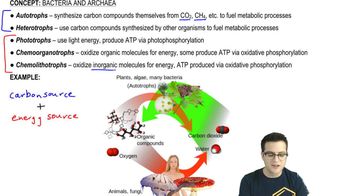
Prokaryote Metabolism

Oxidative Phosphorylation

Oxidative phosphorylation is a metabolic pathway that uses energy released by the oxidation of nutrients to produce ATP. It occurs in the mitochondria during cellular respiration, where electrons are transferred through a series of complexes in the electron transport chain, ultimately reducing oxygen to water and driving the synthesis of ATP. This process is similar to photophosphorylation in its use of a proton gradient to generate ATP.
Recommended video:
Guided course
06:27
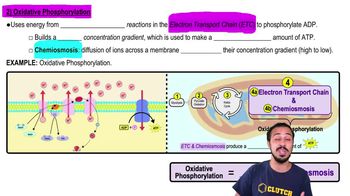
Oxidative Phosphorylation

Electron Transport Chain

The electron transport chain is a series of protein complexes located in the inner mitochondrial membrane (or thylakoid membrane in chloroplasts) that transfer electrons from electron donors to electron acceptors via redox reactions. This transfer of electrons is coupled with the pumping of protons across the membrane, creating a proton gradient that drives ATP synthesis. Both photophosphorylation and oxidative phosphorylation rely on this mechanism to produce ATP.
Recommended video:
Guided course
07:41
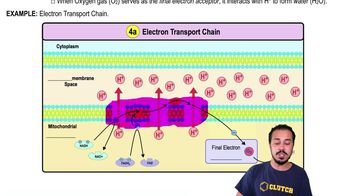
Electron Transport Chain