
Pearson+ LogoPearson+ Logo
Ch. 18 - Regulation of Gene Expression
Campbell - Campbell Biology 11th Edition
Urry11th EditionCampbell BiologyISBN: 9789357423311Not the one you use?Change textbook
Chapter 18, Problem 8

Which of the following statements about the DNA in one of your brain cells is true?
a. Most of the DNA codes for protein.
b. The majority of genes are likely to be transcribed.
c. It is the same as the DNA in one of your liver cells.
d. Each gene lies immediately adjacent to an enhancer.

Verified step by step guidance
1
Understand that DNA is the same in all cells of an organism, meaning the DNA in brain cells is identical to that in liver cells. This is due to the fact that all cells originate from a single fertilized egg and contain the same genetic information.
Recognize that not all DNA codes for proteins. In fact, only a small portion of the DNA in human cells is made up of protein-coding genes. The rest includes non-coding regions, regulatory sequences, and other elements.
Consider that not all genes are actively transcribed in every cell. Gene expression is regulated, and only a subset of genes is transcribed in any given cell type, depending on the cell's function and needs.
Enhancers are regulatory DNA sequences that can increase the transcription of genes. However, they do not necessarily lie immediately adjacent to the genes they regulate. Enhancers can be located at varying distances from their target genes, sometimes even thousands of base pairs away.
Based on these considerations, evaluate each statement to determine which one accurately reflects the nature of DNA in brain cells compared to other cell types in the body.

Verified video answer for a similar problem:

This video solution was recommended by our tutors as helpful for the problem above.
Video duration:
50s
Was this helpful?

Key Concepts

Here are the essential concepts you must grasp in order to answer the question correctly.

DNA Consistency Across Cells

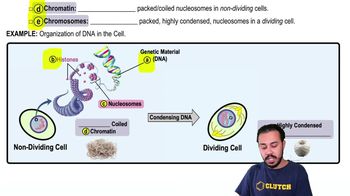
In multicellular organisms, all somatic cells contain the same DNA sequence, regardless of their function or location in the body. This means that the DNA in a brain cell is identical to the DNA in a liver cell. The differences in cell function arise from the expression of different sets of genes, not from differences in the DNA sequence itself.
Recommended video:
Guided course
06:52
Organization of DNA in the Cell

Gene Expression and Transcription

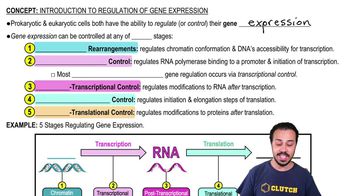
Not all genes in a cell are actively transcribed at any given time. Gene expression is regulated so that only the necessary genes for a cell's function are transcribed. In specialized cells like brain cells, only a subset of genes is transcribed to produce the proteins needed for specific cellular functions, while other genes remain inactive.
Recommended video:
Guided course
06:40
Introduction to Regulation of Gene Expression

DNA Coding for Proteins

In eukaryotic genomes, only a small fraction of the DNA actually codes for proteins. The majority of the DNA consists of non-coding regions, including introns, regulatory sequences, and repetitive elements. These non-coding regions play crucial roles in gene regulation and genome stability, but do not directly code for proteins.
Recommended video:
Related Practice
Textbook Question

Which of the following is an example of post-transcriptional control of gene expression?

a. The addition of methyl groups to cytosine bases of DNA

b. The binding of transcription factors to a promoter

c. The removal of introns and alternative splicing of exons

d. Gene amplification contributing to cancer

2438
views
Textbook Question

What would occur if the repressor of an inducible operon were mutated so it could not bind the operator?

a. Irreversible binding of the repressor to the promoter

b. Reduced transcription of the operon's genes

c. Buildup of a substrate for the pathway controlled by the operon

d. Continuous transcription of the operon's genes

2228
views
Textbook Question

Absence of bicoid mRNA from a Drosophila egg leads to the absence of anterior larval body parts and mirror-image duplication of posterior parts. This is evidence that the product of the bicoid gene

a. Normally leads to formation of head structures.

b. Normally leads to formation of tail structures.

c. Is transcribed in the early embryo.

d. Is a protein present in all head structures.

1802
views
Textbook Question

Within a cell, the amount of protein made using a given mRNA molecule depends partly on

a. The degree of DNA methylation

b. The rate at which the mRNA is degraded

c. The number of introns present in the mRNA

d. The types of ribosomes present in the cytoplasm

2273
views
Textbook Question

Proto-oncogenes can change into oncogenes that cause cancer. Which of the following best explains the presence of these potential time bombs in eukaryotic cells?

a. Proto-oncogenes first arose from viral infections.

b. Proto-oncogenes are mutant versions of normal genes.

c. Proto-oncogenes are genetic 'junk'.

d. Proto-oncogenes normally help regulate cell division.

2142
views