
Pearson+ LogoPearson+ Logo
Ch. 23 - The Evolution of Populations
Campbell - Campbell Biology 11th Edition
Urry11th EditionCampbell BiologyISBN: 9789357423311Not the one you use?Change textbook
Chapter 23, Problem 1

Natural selection changes allele frequencies because some _________ survive and reproduce better than others.
a. Alleles
b. Loci
c. Species
d. Individuals

Verified step by step guidance
1
Understand the concept of natural selection: Natural selection is a process where organisms better adapted to their environment tend to survive and produce more offspring. This leads to changes in allele frequencies in a population over time.
Identify the key components of natural selection: These include variation in traits, differential survival and reproduction, and heredity. The traits that confer a survival advantage are more likely to be passed on to the next generation.
Consider the role of individuals in natural selection: Individuals with advantageous traits are more likely to survive and reproduce, passing those traits to their offspring. This affects the allele frequencies in the population.
Analyze the options given in the problem: a. alleles, b. loci, c. species, d. individuals. Determine which option best fits the context of natural selection affecting allele frequencies.
Conclude that the correct answer is 'd. individuals' because it is the individuals with certain traits that survive and reproduce more successfully, leading to changes in allele frequencies over generations.

Verified video answer for a similar problem:

This video solution was recommended by our tutors as helpful for the problem above.
Video duration:
1m
Was this helpful?

Key Concepts

Here are the essential concepts you must grasp in order to answer the question correctly.

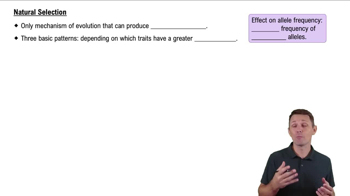
Natural Selection

Natural selection is a fundamental mechanism of evolution, where individuals with traits better suited to their environment tend to survive and reproduce more successfully. This process leads to changes in allele frequencies within a population over time, favoring advantageous traits.
Recommended video:
04:43
Natural Selection

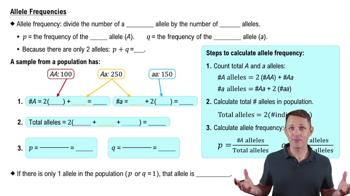
Allele Frequency

Allele frequency refers to how common an allele is in a population. It is a measure of genetic variation and can change due to factors like natural selection, genetic drift, mutation, and gene flow. Changes in allele frequencies are central to the process of evolution.
Recommended video:
06:36
Allele Frequencies

Survival and Reproduction

Survival and reproduction are key components of natural selection. Individuals with traits that enhance their ability to survive and reproduce in a given environment are more likely to pass those traits to the next generation, influencing the genetic makeup of the population.
Recommended video:
Guided course
03:12
Fungi Reproduction - 3