Pearson+ LogoPearson+ Logo
Ch. 33 - An introduction to Invertebrates
Campbell - Campbell Biology 11th Edition
Urry11th EditionCampbell BiologyISBN: 9789357423311Not the one you use?Change textbook
Chapter 33, Problem 6

In Figure 33.7, assume that the two medusae shown at step 4 were produced by one polyp colony. Review Concept 12.1 and Concept 13.3, and then use your understanding of mitosis and meiosis to evaluate whether the following sentence is true or false; if false, select the answer that provides the correct reason. Although the two medusae are genetically identical, a sperm produced by one will differ genetically from an egg produced by the other.
<IMAGE>
a. Both the medusae and the gametes are genetically identical.
b. Neither the medusae nor the gametes are genetically identical.
c. The medusae are not genetically identical, but the gametes are genetically identical.
d. The medusae are genetically identical, but the gametes differ genetically.

Verified step by step guidance
1
Step 1: Review Concept 12.1 to understand the process of mitosis. Mitosis is a type of cell division that results in two genetically identical daughter cells. This process is responsible for the production of medusae from the polyp colony, ensuring that the medusae are genetically identical.
Step 2: Review Concept 13.3 to understand the process of meiosis. Meiosis is a type of cell division that reduces the chromosome number by half and introduces genetic variation through processes like crossing over and independent assortment. This process is responsible for the production of gametes (sperm and eggs).
Step 3: Evaluate the genetic identity of the medusae. Since the medusae are produced by mitosis from the polyp colony, they are genetically identical to each other.
Step 4: Evaluate the genetic identity of the gametes. Gametes are produced through meiosis, which introduces genetic variation. Therefore, a sperm produced by one medusa will differ genetically from an egg produced by the other medusa.
Step 5: Based on the above analysis, determine that the correct answer is (d): The medusae are genetically identical, but the gametes differ genetically.

Verified video answer for a similar problem:

This video solution was recommended by our tutors as helpful for the problem above.
Video duration:
1m
Was this helpful?

Key Concepts

Here are the essential concepts you must grasp in order to answer the question correctly.

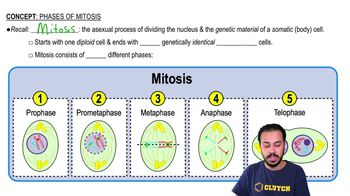
Mitosis

Mitosis is a type of cell division that results in two genetically identical daughter cells, each with the same number of chromosomes as the parent cell. It is essential for growth, repair, and asexual reproduction in organisms. In the context of the question, the medusae produced by the polyp colony are genetically identical due to mitotic division.
Recommended video:
Guided course
03:21
Phases of Mitosis

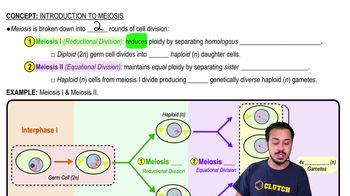
Meiosis

Meiosis is a specialized form of cell division that reduces the chromosome number by half, resulting in four genetically diverse gametes. This process is crucial for sexual reproduction, as it introduces genetic variation through recombination and independent assortment. The sperm and egg produced by the medusae will differ genetically due to meiosis.
Recommended video:
Guided course
04:49
Meiosis I & Meiosis II

Genetic Identity

Genetic identity refers to the genetic similarity between organisms or cells. In this scenario, the medusae are genetically identical to each other because they originate from the same polyp colony through mitosis. However, the gametes (sperm and egg) produced by these medusae are genetically distinct due to the process of meiosis, which creates variation.
Recommended video: