Ch. 33 - An introduction to Invertebrates
Campbell - Campbell Biology 11th Edition
Urry11th EditionCampbell BiologyISBN: 9789357423311Not the one you use?Change textbook
Chapter 33, Problem 3

The water vascular system of echinoderms
a. Functions as a circulatory system that distributes nutrients to body cells
b. Functions in locomotion and feeding
c. Is bilateral in organization, even though the adult animal is not bilaterally symmetrical
d. Moves water through the animal's body during filter feeding

Verified step by step guidance
1
Understand the water vascular system: The water vascular system is a network of hydraulic canals unique to echinoderms, such as starfish and sea urchins. It plays a crucial role in their physiology.
Identify the primary functions: The water vascular system is primarily involved in locomotion, feeding, and respiration. It helps echinoderms move and capture food using tube feet.
Analyze the options: Consider each option provided in the problem. Option a suggests a circulatory function, which is not the primary role of the water vascular system. Option b mentions locomotion and feeding, which aligns with the known functions. Option c refers to bilateral organization, which is not characteristic of echinoderms. Option d suggests movement of water during filter feeding, which is not the primary function.
Focus on locomotion and feeding: The water vascular system uses hydraulic pressure to extend and retract tube feet, allowing echinoderms to move and manipulate food. This is a key aspect of their feeding and movement.
Conclude with the correct function: Based on the analysis, the water vascular system's primary role is in locomotion and feeding, making option b the most accurate description.

Verified video answer for a similar problem:

This video solution was recommended by our tutors as helpful for the problem above.
Video duration:
34s
Was this helpful?

Key Concepts

Here are the essential concepts you must grasp in order to answer the question correctly.

Water Vascular System

The water vascular system is a network of hydraulic canals unique to echinoderms, such as starfish and sea urchins. It plays a crucial role in locomotion, feeding, and respiration by using water pressure to extend and retract tube feet, allowing the organism to move and capture food. This system is not primarily involved in nutrient distribution, distinguishing it from circulatory systems.
Recommended video:
Guided course
06:08
Seedless Vascular Plants

Echinoderm Symmetry

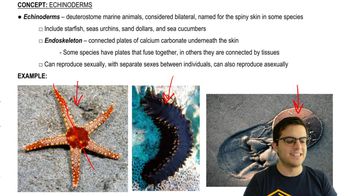
Echinoderms exhibit radial symmetry as adults, meaning their body parts are arranged around a central axis. This contrasts with bilateral symmetry, where body parts are mirrored on either side of a central plane. The radial symmetry of echinoderms is a key adaptation for their sessile or slow-moving lifestyle, allowing them to interact with the environment from all sides.
Recommended video:

Locomotion and Feeding in Echinoderms

Echinoderms use their water vascular system for locomotion and feeding. Tube feet, powered by hydraulic pressure, enable movement across surfaces and manipulation of food items. This system allows echinoderms to adhere to surfaces, capture prey, and transport food to their mouths, highlighting its importance in their survival and ecological role.
Recommended video:
Related Practice
Textbook Question

A land snail, a clam, and an octopus all share

a. A mantle

b. A radula

c. Gills

d. Distinct cephalization

980
views
Textbook Question

Which phylum is characterized by animals that have a segmented body?

a. Cnidaria

b. Platyhelminthes

c. Arthropoda

d. Mollusca

1483
views
Textbook Question

Which of the following combinations of phylum and description is incorrect?

a. Echinodermata—bilateral symmetry as a larva, coelomate

b. Nematoda—roundworms, pseudocoelomate

c. Platyhelminthes—flatworms, gastrovascular cavity, acoelomate

d. Porifera—gastrovascular cavity, coelomate

1581
views
Textbook Question

In the following figure, which two main clades branch from the most recent common ancestor of the eumetazoans?

a. Porifera and Cnidaria

b. Lophotrochozoa and Ecdysozoa

c. Cnidaria and Bilateria

d. Deuterostomia and Bilateria

<IMAGE>

1215
views
Textbook Question

In Figure 33.7, assume that the two medusae shown at step 4 were produced by one polyp colony. Review Concept 12.1 and Concept 13.3, and then use your understanding of mitosis and meiosis to evaluate whether the following sentence is true or false; if false, select the answer that provides the correct reason. Although the two medusae are genetically identical, a sperm produced by one will differ genetically from an egg produced by the other.

<IMAGE>

a. Both the medusae and the gametes are genetically identical.

b. Neither the medusae nor the gametes are genetically identical.

c. The medusae are not genetically identical, but the gametes are genetically identical.

d. The medusae are genetically identical, but the gametes differ genetically.
817
views