Pearson+ LogoPearson+ Logo
Ch. 35 - Vascular Plant Structure, Growth, and Development
Campbell - Campbell Biology 11th Edition
Urry11th EditionCampbell BiologyISBN: 9789357423311Not the one you use?Change textbook
Chapter 35, Problem 7

Which of the following would not be seen in a cross section through the woody part of a root?
a. Sclerenchyma cells
b. Parenchyma cells
c. Sieve-tube elements
d. Root hairs

Verified step by step guidance
1
Understand the structure of a woody root: Woody roots are primarily composed of secondary xylem and secondary phloem, which are produced by the vascular cambium.
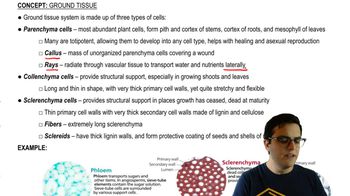
Identify the types of cells typically found in woody roots: Woody roots contain sclerenchyma cells, parenchyma cells, and various elements of the vascular system such as xylem and phloem cells.
Recognize the function and location of sieve-tube elements: Sieve-tube elements are part of the phloem tissue, responsible for transporting nutrients throughout the plant. They are typically found in the vascular system.
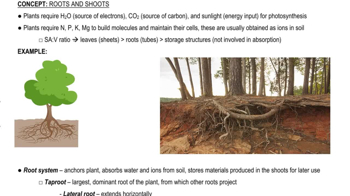
Consider the role and location of root hairs: Root hairs are extensions of epidermal cells that increase surface area for absorption. They are found on the outer surface of roots, not within the woody part.
Determine which option is not typically found in a cross section of the woody part of a root: Since root hairs are located on the outer surface and not within the woody part, they would not be seen in a cross section through the woody part of a root.

Verified video answer for a similar problem:

This video solution was recommended by our tutors as helpful for the problem above.
Video duration:
3m
Was this helpful?

Key Concepts

Here are the essential concepts you must grasp in order to answer the question correctly.

Woody Root Structure

The woody part of a root primarily consists of xylem and phloem tissues, which are responsible for water and nutrient transport. Xylem includes vessels and tracheids, while phloem contains sieve-tube elements and companion cells. Understanding the composition of these tissues is crucial for identifying what structures are present in a cross-section of a woody root.
Recommended video:

Sclerenchyma Cells

Sclerenchyma cells are a type of plant cell known for their thick, lignified walls, providing structural support to the plant. They are commonly found in various parts of the plant, including stems and roots, often associated with vascular tissues. Their presence in woody roots is typical due to their supportive role.
Recommended video:
Guided course
04:03
Ground Tissue Cells

Root Hairs

Root hairs are extensions of root epidermal cells that increase the surface area for water and nutrient absorption. They are typically found in the root's non-woody parts, particularly in the region of maturation. In a cross-section of a woody root, root hairs are absent as they are part of the outermost layer, not the internal woody structure.
Recommended video: