Pearson+ LogoPearson+ Logo
Ch. 37 - Soil and Plant Nutrition
Campbell - Campbell Biology 11th Edition
Urry11th EditionCampbell BiologyISBN: 9789357423311Not the one you use?Change textbook
Chapter 37, Problem 10

Draw a simple sketch of cation exchange, showing a root hair, a soil particle with anions, and a hydrogen ion displacing a mineral cation.

Verified step by step guidance
1
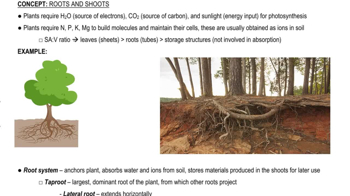
Begin by drawing a root hair extending from a plant root. This represents the part of the plant that interacts with soil particles to absorb nutrients.
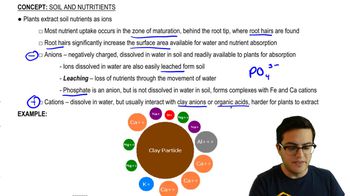
Next, draw a soil particle near the root hair. Soil particles are often negatively charged due to the presence of anions such as clay and organic matter.
On the surface of the soil particle, illustrate several anions (negatively charged ions) to indicate the negative charge of the soil particle.
Now, add a mineral cation (positively charged ion) such as calcium (Ca2+) or potassium (K+) near the soil particle. These cations are attracted to the negatively charged soil particle.
Finally, draw a hydrogen ion (H+) being released from the root hair. Show this hydrogen ion displacing the mineral cation from the soil particle, illustrating the process of cation exchange where the hydrogen ion replaces the mineral cation, allowing the plant to absorb the mineral cation.

Verified video answer for a similar problem:

This video solution was recommended by our tutors as helpful for the problem above.
Video duration:
2m
Was this helpful?

Key Concepts

Here are the essential concepts you must grasp in order to answer the question correctly.

Cation Exchange

Cation exchange is a process where cations (positively charged ions) in the soil are exchanged with cations from plant roots. This is crucial for nutrient uptake, as plants release hydrogen ions (H+) into the soil, which displace nutrient cations like potassium (K+), calcium (Ca2+), and magnesium (Mg2+) from soil particles, making them available for absorption by the plant roots.
Recommended video:
Guided course
06:26
Cation Exchange

Root Hair Function

Root hairs are extensions of root epidermal cells that increase the surface area for water and nutrient absorption. They play a vital role in cation exchange by releasing hydrogen ions into the soil, which helps displace nutrient cations from soil particles, facilitating their uptake into the plant. This process is essential for the plant's nutrient acquisition and overall health.
Recommended video:

Soil Particle Charge

Soil particles, particularly clay and organic matter, often carry a negative charge, which attracts and holds onto cations. This electrostatic attraction is the basis for cation exchange, as the negatively charged soil particles bind with positively charged nutrient ions. Understanding this charge interaction is key to comprehending how nutrients are retained in the soil and made available to plants through cation exchange.
Recommended video:
Guided course
06:13
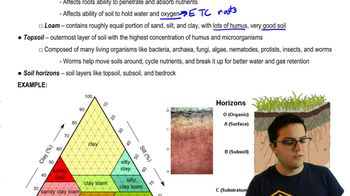
Soil Composition
Related Practice
Textbook Question

The greatest difference in health between two groups of plants of the same species, one group with mycorrhizae and one group without mycorrhizae, would be in an environment

a. Where nitrogen-fixing bacteria are abundant

b. That has soil with poor drainage

c. That has hot summers and cold winters

d. In which the soil is relatively deficient in mineral nutrients

973
views
Textbook Question

Two groups of tomatoes were grown under laboratory conditions, one with humus added to the soil and one as a control without humus. The leaves of the plants grown without humus were yellowish (less green) compared with those of the plants grown in humus-enriched soil. The best explanation is that

a. The healthy plants used the food in the decomposing leaves of the humus for energy to make chlorophyll.

b. The humus made the soil more loosely packed, so water penetrated more easily to the roots.

c. The humus contained minerals such as magnesium and iron needed for the synthesis of chlorophyll.

d. The heat released by the decomposing leaves of the humus caused more rapid growth and chlorophyll synthesis.

1189
views
Textbook Question

The specific relationship between a legume and its mutualistic Rhizobium strain probably depends on:

a. Each legume having a chemical dialogue with a fungus

b. Each Rhizobium strain having a form of nitrogenase that works only in the appropriate legume host

c. Each legume being found where the soil has only the Rhizobium specific to that legume

d. Specific recognition between chemical signals and signal receptors of the Rhizobium strain and legume species

1016
views