Pearson+ LogoPearson+ Logo
Ch. 40 - Basic Principles of Animal Form and Function
Campbell - Campbell Biology 11th Edition
Urry11th EditionCampbell BiologyISBN: 9789357423311Not the one you use?Change textbook
Chapter 40, Problem 4

Compared with a smaller cell, a larger cell of the same shape has
a. Less surface area
b. Less surface area per unit of volume
c. The same surface-area-to-volume ratio
d. A smaller cytoplasm-to-nucleus ratio

Verified step by step guidance
1
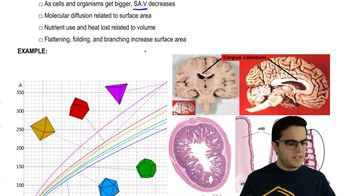
Understand the concept of surface area-to-volume ratio: As a cell increases in size, its volume grows faster than its surface area. This is because volume is a cubic function, while surface area is a square function.
Calculate the surface area and volume for a hypothetical smaller cell and a larger cell of the same shape. For example, if the cells are spherical, use the formulas: Surface Area = 4πr² and Volume = (4/3)πr³, where r is the radius of the sphere.
Determine the surface area-to-volume ratio for both cells by dividing the surface area by the volume for each cell.
Compare the surface area-to-volume ratios of the smaller and larger cells. Notice that as the cell size increases, the surface area-to-volume ratio decreases.
Conclude that a larger cell has less surface area per unit of volume compared to a smaller cell, which corresponds to option b.

Verified video answer for a similar problem:

This video solution was recommended by our tutors as helpful for the problem above.
Video duration:
2m
Was this helpful?

Key Concepts

Here are the essential concepts you must grasp in order to answer the question correctly.

Surface Area to Volume Ratio

The surface area to volume ratio is a critical concept in cell biology, describing how the surface area of a cell changes relative to its volume as the cell size increases. As a cell grows, its volume increases faster than its surface area, leading to a decreased surface area to volume ratio. This affects the cell's ability to efficiently exchange materials with its environment, impacting processes like nutrient uptake and waste removal.
Recommended video:
Guided course
07:47
Surface Area to Volume Ratio

Cell Size and Shape

Cell size and shape are important factors that influence a cell's function and efficiency. Larger cells have more cytoplasm and require more resources, but their surface area does not increase proportionally, which can limit the rate of diffusion of substances across the cell membrane. The shape of a cell can also affect its surface area to volume ratio, with elongated or flattened shapes often having higher ratios than spherical ones.
Recommended video:
Guided course
01:52
Population Size & Density

Cytoplasm-to-Nucleus Ratio

The cytoplasm-to-nucleus ratio refers to the relative volume of cytoplasm compared to the nucleus within a cell. This ratio can influence cellular functions such as gene expression and cell division. In larger cells, the cytoplasm-to-nucleus ratio may decrease, potentially affecting the cell's ability to efficiently manage its metabolic activities and maintain homeostasis.
Recommended video:
Related Practice
Textbook Question

The body tissue that consists largely of material located outside of cells is

a. Epithelial tissue

b. Connective tissue

c. Muscle tissue

d. Nervous tissue

2384
views
2
rank
Textbook Question

Which of the following would increase the rate of heat exchange between an animal and its environment?

a. Feathers or fur

b. Vasoconstriction

c. Wind blowing across the body surface

d. Countercurrent heat exchanger

1209
views
Textbook Question

Consider the energy budgets for a human, an elephant, a penguin, a mouse, and a snake. The would have the highest total annual energy expenditure, and the would have the highest energy expenditure per unit mass.

a. Elephant; mouse

b. Elephant; human

c. Mouse; snake

d. Penguin; mouse

875
views
Textbook Question

An animal's inputs of energy and materials would exceed its outputs

a. If the animal is an endotherm, which must always take in more energy because of its high metabolic rate

b. If it is actively foraging for food

c. If it is growing and increasing its mass

d. Never; due to homeostasis, these energy and material budgets always balance

1310
views
Textbook Question

You are studying a large tropical reptile that has a high and relatively stable body temperature. How do you determine whether this animal is an endotherm or an ectotherm?

a. You know from its high and stable body temperature that it must be an endotherm.

b. You subject this reptile to various temperatures in the lab and find that its body temperature and metabolic rate change with the ambient temperature. You conclude that it is an ectotherm.

c. You note that its environment has a high and stable temperature. Because its body temperature matches the environmental temperature, you conclude that it is an ectotherm.

d. You measure the metabolic rate of the reptile, and because it is higher than that of a related species that lives in temperate forests, you conclude that this reptile is an endotherm and its relative is an ectotherm.

1743
views
Textbook Question

Which of the following animals uses the largest percentage of its energy budget for homeostatic regulation?

a. Marine jelly (an invertebrate)

b. Snake in a temperate forest

c. Desert insect

d. Desert bird

882
views