Pearson+ LogoPearson+ Logo
Ch. 43 - The Immune System
Campbell - Campbell Biology 11th Edition
Urry11th EditionCampbell BiologyISBN: 9789357423311Not the one you use?Change textbook
Chapter 43, Problem 4

Which of the following statements is not true?
a. An antibody has more than one antigen-binding site.
b. A lymphocyte has receptors for multiple different antigens.
c. An antigen can have different epitopes.
d. A liver or muscle cell makes one class of MHC molecule.

Verified step by step guidance
1
Understand the role of antibodies: Antibodies are proteins produced by the immune system to identify and neutralize foreign objects like bacteria and viruses. Each antibody has multiple antigen-binding sites, typically two, allowing it to bind to antigens.
Examine lymphocyte receptors: Lymphocytes, such as B cells and T cells, have receptors on their surfaces. Each lymphocyte is specific to a single antigen, meaning it has receptors for only one type of antigen, not multiple different antigens.
Explore antigen structure: Antigens are substances that can induce an immune response. They can have multiple epitopes, which are specific parts of the antigen that antibodies or receptors bind to.
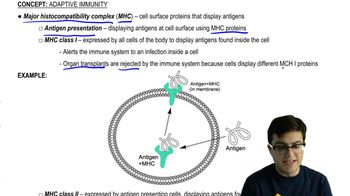
Review MHC molecules: Major Histocompatibility Complex (MHC) molecules are proteins found on the surface of cells that present antigen fragments to T cells. Different cells express different classes of MHC molecules. For example, liver or muscle cells typically express MHC class I molecules.
Identify the incorrect statement: Based on the understanding of antibodies, lymphocytes, antigens, and MHC molecules, determine which statement does not align with biological principles. Focus on the statement about lymphocyte receptors, as it contradicts the specificity of lymphocytes to a single antigen.

Verified video answer for a similar problem:

This video solution was recommended by our tutors as helpful for the problem above.
Video duration:
5m
Was this helpful?

Key Concepts

Here are the essential concepts you must grasp in order to answer the question correctly.

Antibody Structure

Antibodies are Y-shaped proteins produced by B cells that have multiple antigen-binding sites, typically two, allowing them to bind to specific antigens. These binding sites are located at the tips of the 'Y' and are highly variable, enabling the immune system to recognize a vast array of antigens.
Recommended video:
Guided course
04:25
Community Structure

Lymphocyte Receptors

Lymphocytes, such as B cells and T cells, have receptors that are specific to one type of antigen. Each lymphocyte is equipped with receptors that recognize a unique antigen, ensuring a targeted immune response. This specificity is crucial for the adaptive immune system's ability to remember and respond to pathogens.
Recommended video:
Guided course
02:28
Intracellular Receptors

Major Histocompatibility Complex (MHC)

MHC molecules are proteins found on the surface of cells that present antigen fragments to T cells. There are two main classes: MHC class I, present on almost all nucleated cells, and MHC class II, found on specialized antigen-presenting cells. Liver and muscle cells typically express MHC class I molecules, which are essential for presenting intracellular antigens to cytotoxic T cells.
Recommended video:
Guided course
04:04
Major Histocompatibility Complex
Related Practice
Textbook Question

Which of these is not part of insect immunity?

a. Enzyme activation of pathogen-killing chemicals

b. Activation of natural killer cells

c. Phagocytosis by hemocytes

d. Production of antimicrobial peptides

973
views
Textbook Question

An epitope associates with which part of an antigen receptor or antibody?

a. The tail

b. The heavy-chain constant regions only

c. Variable regions of a heavy chain and light chain combined

d. The light-chain constant regions only

1257
views
Textbook Question

Which statement best describes the difference between responses of effector B cells (plasma cells) and those of cytotoxic T cells?

a. B cells confer active immunity; cytotoxic T cells confer passive immunity.

b. B cells respond the first time a pathogen is present; cytotoxic T cells respond subsequent times.

c. B cells secrete antibodies against a pathogen; cytotoxic T cells kill pathogen-infected host cells.

d. B cells carry out the cell-mediated response; cytotoxic T cells carry out the humoral response.

2086
views
Textbook Question

Which of the following statements is true?

a. An antibody has one antigen-binding site

b. A lymphocyte has receptors for a single antigen

c. Every antigen has a single epitope

d. A liver or muscle cell makes two classes of MHC molecule

1727
views
1
rank
Textbook Question

Which of the following should be the same in identical twins?

a. The set of antibodies produced

b. The set of MHC molecules produced

c. The set of T cell antigen receptors produced

d. The set of immune cells eliminated as self-reactive

1465
views