
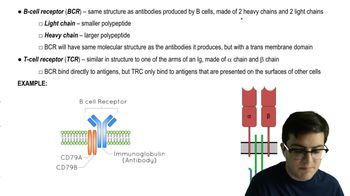
An epitope associates with which part of an antigen receptor or antibody?
a. The tail
b. The heavy-chain constant regions only
c. Variable regions of a heavy chain and light chain combined
d. The light-chain constant regions only
Verified step by step guidance
An epitope associates with which part of an antigen receptor or antibody?
a. The tail
b. The heavy-chain constant regions only
c. Variable regions of a heavy chain and light chain combined
d. The light-chain constant regions only
Which statement best describes the difference between responses of effector B cells (plasma cells) and those of cytotoxic T cells?
a. B cells confer active immunity; cytotoxic T cells confer passive immunity.
b. B cells respond the first time a pathogen is present; cytotoxic T cells respond subsequent times.
c. B cells secrete antibodies against a pathogen; cytotoxic T cells kill pathogen-infected host cells.
d. B cells carry out the cell-mediated response; cytotoxic T cells carry out the humoral response.
Which of the following statements is not true?
a. An antibody has more than one antigen-binding site.
b. A lymphocyte has receptors for multiple different antigens.
c. An antigen can have different epitopes.
d. A liver or muscle cell makes one class of MHC molecule.
Which of the following should be the same in identical twins?
a. The set of antibodies produced
b. The set of MHC molecules produced
c. The set of T cell antigen receptors produced
d. The set of immune cells eliminated as self-reactive