Pearson+ LogoPearson+ Logo
Ch. 5 - The Structure and Function of Large Biological Molecules
Campbell - Campbell Biology 11th Edition
Urry11th EditionCampbell BiologyISBN: 9789357423311Not the one you use?Change textbook
Chapter 5, Problem 4

The structural level of a protein least affected by a disruption in hydrogen bonding is the
a. Primary level.
b. Secondary level.
c. Tertiary level.
d. Quaternary level.

Verified step by step guidance
1
Understand the structural levels of proteins: Proteins have four levels of structure - primary, secondary, tertiary, and quaternary.
Identify the primary structure: The primary structure is the sequence of amino acids in a polypeptide chain, held together by peptide bonds.
Recognize the role of hydrogen bonds: Hydrogen bonds are crucial in stabilizing the secondary, tertiary, and quaternary structures of proteins.
Analyze the secondary structure: The secondary structure includes alpha helices and beta sheets, which are stabilized by hydrogen bonds.
Determine the least affected level: Since the primary structure is held together by peptide bonds and not hydrogen bonds, it is the structural level least affected by a disruption in hydrogen bonding.

Verified video answer for a similar problem:

This video solution was recommended by our tutors as helpful for the problem above.
Video duration:
44s
Was this helpful?

Key Concepts

Here are the essential concepts you must grasp in order to answer the question correctly.

Protein Structure Levels

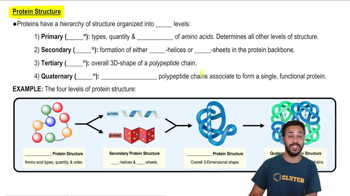
Proteins have four structural levels: primary, secondary, tertiary, and quaternary. The primary structure is the sequence of amino acids, the secondary structure includes alpha helices and beta sheets formed by hydrogen bonds, the tertiary structure is the overall 3D shape, and the quaternary structure involves multiple polypeptide chains. Understanding these levels is crucial for determining how disruptions affect protein structure.
Recommended video:
Guided course
08:02
Protein Structure

Hydrogen Bonding in Proteins

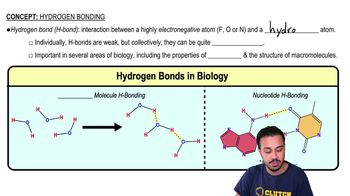
Hydrogen bonds are weak interactions that play a significant role in stabilizing the secondary and tertiary structures of proteins. They occur between the backbone atoms in the secondary structure and between side chains in the tertiary structure. Disruption of hydrogen bonds can lead to changes in protein folding and stability, affecting its function.
Recommended video:
Guided course
05:03
Hydrogen Bonding

Primary Structure Stability

The primary structure of a protein, which is the linear sequence of amino acids, is held together by covalent peptide bonds. Unlike hydrogen bonds, peptide bonds are strong and not easily disrupted by changes in environmental conditions. Therefore, the primary structure remains intact even when hydrogen bonding is disrupted, making it the least affected structural level.
Recommended video:
Guided course
02:22
Primary Production in Terrestrial Ecosystems
Related Practice
Textbook Question

Which of the following categories includes all others in the list?

a. Disaccharide

b. Polysaccharide

c. Starch

d. Carbohydrate

2555
views
1
rank
Textbook Question

The enzyme amylase can break glycosidic linkages between glucose monomers only if the monomers are in the α form. Which of the following could amylase break down?

a. glycogen, starch, and amylopectin

b. glycogen and cellulose

c. cellulose and chitin

d. starch, chitin, and cellulose

4240
views
Textbook Question

Which of the following is true of unsaturated fats?

a. They are more common in animals than in plants.

b. They have double bonds in their fatty acid chains.

c. They generally solidify at room temperature.

d. They contain more hydrogen than do saturated fats having the same number of carbon atoms.

4158
views
Textbook Question

Enzymes that break down DNA catalyze the hydrolysis of the covalent bonds that join nucleotides together. What would happen to DNA molecules treated with these enzymes?

a. The two strands of the double helix would separate.

b. The phosphodiester linkages of the polynucleotide backbone would be broken.

c. The pyrimidines would be separated from the deoxyribose sugars.

d. All bases would be separated from the deoxyribose sugars.

3284
views
Textbook Question

The molecular formula for glucose is C6H12O6. What would be the molecular formula for a polymer made by linking ten glucose molecules together by dehydration reactions?

a. C60H120O60

b. C60H102O51

c. C60H100O50

d. C60H111O51

5222
views
Textbook Question

Which of the following pairs of base sequences could form a short stretch of a normal double helix of DNA?

a. 5′-AGCT-3′ with 5′-TCGA-3′

b. 5′-GCGC-3′ with 5′-TATA-3′

c. 5′-ATGC-3′ with 5′-GCAT-3′

d. All of these pairs are correct.

3360
views