Ch. 1 - Biology: The Study of Life
Freeman - Biological Science 8th Edition
Freeman8th EditionBiological ScienceISBN: 9780138276263Not the one you use?Change textbook
Chapter 1, Problem 2

What does it mean to say that experimental conditions are controlled? Select True or False for each statement.
T/F The test groups consist of the same individuals.
T/F The null hypothesis is correct.
T/F There is no difference in outcome between the control and experimental treatment.
T/F All physical conditions except for one are identical for all groups tested.

Verified step by step guidance
1
Understand the concept of controlled experimental conditions: In a controlled experiment, researchers manipulate one variable while keeping all other variables constant to determine the effect of the manipulated variable.
Evaluate the statement 'The test groups consist of the same individuals': Consider whether using the same individuals in both test and control groups is a standard practice in controlled experiments.
Evaluate the statement 'The null hypothesis is correct': Understand that the null hypothesis is a statement that there is no effect or no difference, and its correctness is determined by the experiment's results, not by the experimental conditions.
Evaluate the statement 'There is no difference in outcome between the control and experimental treatment': Consider whether this statement aligns with the purpose of a controlled experiment, which is to identify differences caused by the manipulated variable.
Evaluate the statement 'All physical conditions except for one are identical for all groups tested': Recognize that this is a key feature of controlled experiments, where only the independent variable is changed while all other conditions are kept constant.

Verified video answer for a similar problem:

This video solution was recommended by our tutors as helpful for the problem above.
Video duration:
3m
Was this helpful?

Key Concepts

Here are the essential concepts you must grasp in order to answer the question correctly.

Controlled Experiment

A controlled experiment is a scientific test where all variables are kept constant except for the one being tested. This ensures that any observed effects on the dependent variable can be attributed to changes in the independent variable. By controlling extraneous variables, researchers can isolate the cause-and-effect relationship.
Recommended video:
Guided course
08:56
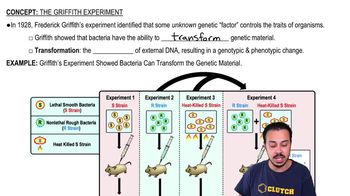
The Griffith Experiment

Control Group

A control group is a baseline group in an experiment that does not receive the experimental treatment. It is used for comparison to determine the effect of the treatment. The control group is exposed to the same conditions as the experimental group, except for the variable being tested, ensuring that any differences in outcomes can be attributed to the treatment.
Recommended video:
Guided course
06:04
Functional Groups

Null Hypothesis

The null hypothesis is a statement used in statistics that proposes no significant effect or relationship between variables in an experiment. It serves as a default or starting assumption that the experiment seeks to test. If the experimental data significantly deviate from what the null hypothesis predicts, it may be rejected, suggesting a potential effect or relationship.
Recommended video:
Guided course
08:22
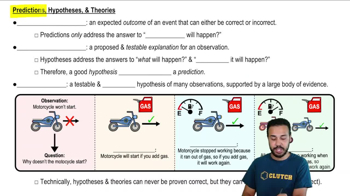
Predictions, Hypotheses, & Theories