Pearson+ LogoPearson+ Logo
Ch. 6 - Lipids, Membranes, and the First Cells
Freeman - Biological Science 8th Edition
Freeman8th EditionBiological ScienceISBN: 9780138276263Not the one you use?Change textbook
Chapter 6, Problem 1

How do the phospholipids in archaea differ from those in other cells?
a. They have tails made of unsaturated fatty acids instead of saturated fatty acids.
b. They do not contain hydrocarbon chains.
c. They have isoprenoid tails instead of fatty acid tails.
d. They have two hydrocarbon chains instead of three hydrocarbon chains.

Verified step by step guidance
1
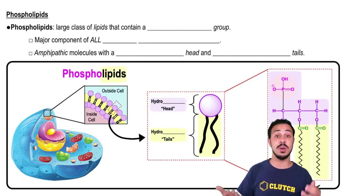
Understand the structure of phospholipids in general: Phospholipids are composed of a hydrophilic (water-attracting) head and hydrophobic (water-repelling) tails. In most cells, the tails are made of fatty acids, which are long hydrocarbon chains.
Learn about the unique characteristics of archaea: Archaea are a distinct domain of life, and their cell membranes are adapted to extreme environments. Their phospholipids differ structurally from those in bacteria and eukaryotes.
Compare the tails of phospholipids in archaea to those in other cells: In archaea, the hydrophobic tails are made of isoprenoid chains rather than fatty acid chains. Isoprenoid chains are branched hydrocarbons, which provide stability in extreme conditions.
Review the chemical linkage in archaea phospholipids: The isoprenoid chains in archaea are attached to the glycerol backbone via ether bonds, whereas in other cells, fatty acid chains are attached via ester bonds. This difference contributes to the stability of archaeal membranes.
Match the correct answer to the structural difference: Based on the information, the correct answer is c. Archaea have isoprenoid tails instead of fatty acid tails.

Verified video answer for a similar problem:

This video solution was recommended by our tutors as helpful for the problem above.
Video duration:
1m
Was this helpful?

Key Concepts

Here are the essential concepts you must grasp in order to answer the question correctly.

Phospholipid Structure

Phospholipids are molecules that form the fundamental structure of cell membranes. They consist of a hydrophilic (water-attracting) 'head' and two hydrophobic (water-repelling) 'tails.' The arrangement of these molecules creates a bilayer that serves as a barrier to protect the cell and regulate the movement of substances in and out.
Recommended video:
Guided course
04:05
Phospholipids

Archaea Membrane Composition

Archaea have unique membrane lipids that differ from those of bacteria and eukaryotes. Instead of fatty acids, archaea typically have isoprenoid chains, which are branched hydrocarbons. This structural difference contributes to the stability of archaeal membranes, especially in extreme environments where many archaea thrive.
Recommended video:
Guided course
06:13
Soil Composition

Saturated vs. Unsaturated Fatty Acids

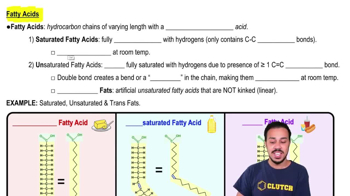
Fatty acids can be classified as saturated or unsaturated based on their chemical structure. Saturated fatty acids have no double bonds between carbon atoms, leading to a straight structure, while unsaturated fatty acids contain one or more double bonds, resulting in kinks. This distinction affects the fluidity and functionality of cell membranes, influencing how cells respond to environmental changes.
Recommended video: