Ch. 3 - Polynomial and Rational Functions
Blitzer - College Algebra 8th Edition
Blitzer8th EditionCollege AlgebraISBN: 9780136970514Not the one you use?Change textbook
Chapter 4, Problem 11

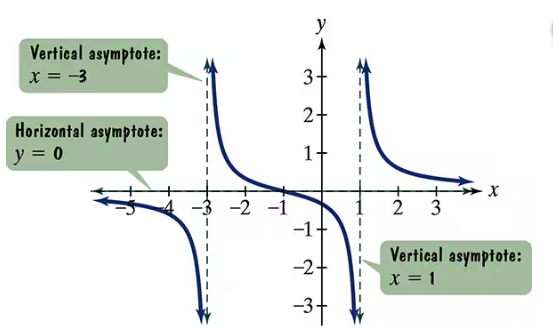
Use the graph of the rational function in the figure shown to complete each statement in Exercises 9–14.

As x→1−, f(x)→x\(\to\)1^{-},\(\text{ }\)f(x)\(\to\)_{_{}}______

Verified step by step guidance
1
Identify the point of interest on the x-axis, which is \(x \to 1^-\), meaning we are approaching 1 from the left side.
Look at the graph near \(x = 1\) and observe the behavior of the function \(f(x)\) as \(x\) approaches 1 from values less than 1.
Notice that the graph is very close to the horizontal asymptote \(y = 0\) near \(x = 1\), and the function values are slightly below zero.
Since the function values are approaching zero from the negative side as \(x\) approaches 1 from the left, we conclude that \(f(x) \to 0^-\) as \(x \to 1^-\).
Therefore, the limit of \(f(x)\) as \(x\) approaches 1 from the left is 0, but the function values are slightly negative.

Verified video answer for a similar problem:

This video solution was recommended by our tutors as helpful for the problem above.
Video duration:
1m

Key Concepts

Here are the essential concepts you must grasp in order to answer the question correctly.

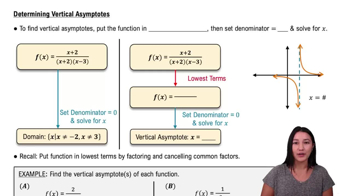
Vertical Asymptotes

Vertical asymptotes occur where a function approaches infinity or negative infinity as the input approaches a specific value. They indicate values of x where the function is undefined, often due to division by zero in rational functions. In the graph, vertical asymptotes are shown at x = 6 and x = 14.
Recommended video:
3:12
Determining Vertical Asymptotes

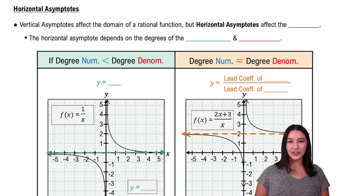
Horizontal Asymptotes

A horizontal asymptote represents the value that a function approaches as x approaches positive or negative infinity. It shows the end behavior of the function. In this graph, the horizontal asymptote is y = 0, meaning the function values get closer to zero as x becomes very large or very small.
Recommended video:
4:48
Determining Horizontal Asymptotes

Limit Behavior Near a Point

The limit of a function as x approaches a specific value from the left or right describes the function's behavior near that point. For example, as x approaches 1 from the left (x → 1⁻), the function value approaches a certain number or infinity. Understanding this helps in analyzing function continuity and asymptotic behavior.
Recommended video:
05:01
Identifying Intervals of Unknown Behavior