Ch. 3 - Polynomial and Rational Functions
Blitzer - College Algebra 8th Edition
Blitzer8th EditionCollege AlgebraISBN: 9780136970514Not the one you use?Change textbook
Chapter 4, Problem 8

In Exercises 1–10, determine which functions are polynomial functions. For those that are, identify the degree. f(x)=x1/3 −4x2+7

Verified step by step guidance
1
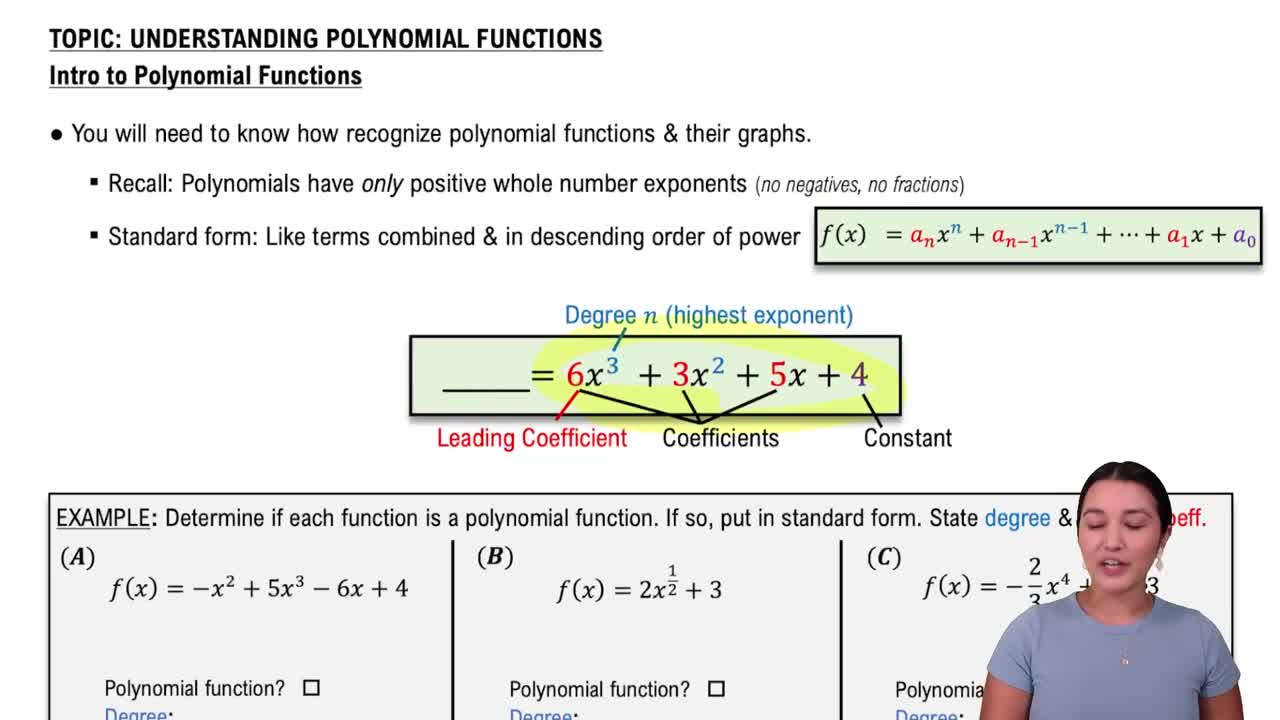
Recall that a polynomial function is a function of the form f(x) = anxn + an-1xn-1 + ... + a0 where each exponent n is a non-negative integer (0, 1, 2, ...).
Examine each term of the function f(x) = x1 3 4x2 + 7: the first term is x1 3, the second term is 4x2, and the third term is the constant 7.
Check the exponents of each term: the first term has an exponent of 1 3 (which is a fraction), the second term has an exponent of 2 (which is a non-negative integer), and the constant term can be considered as x0.
Since the first term has a fractional exponent, it violates the definition of a polynomial function, which requires all exponents to be whole numbers (non-negative integers).
Therefore, conclude that f(x) = x1 3 − 4x^2 + 7 is not a polynomial function.

Verified video answer for a similar problem:

This video solution was recommended by our tutors as helpful for the problem above.
Video duration:
2m
Was this helpful?

Key Concepts

Here are the essential concepts you must grasp in order to answer the question correctly.

Polynomial Functions

A polynomial function is a function that can be expressed as a sum of terms consisting of variables raised to non-negative integer exponents multiplied by coefficients. For example, f(x) = 3x^2 - 5x + 7 is a polynomial, but functions with variables under roots or with fractional exponents are not considered polynomials.
Recommended video:
06:04
Introduction to Polynomial Functions

Exponents and Their Restrictions in Polynomials

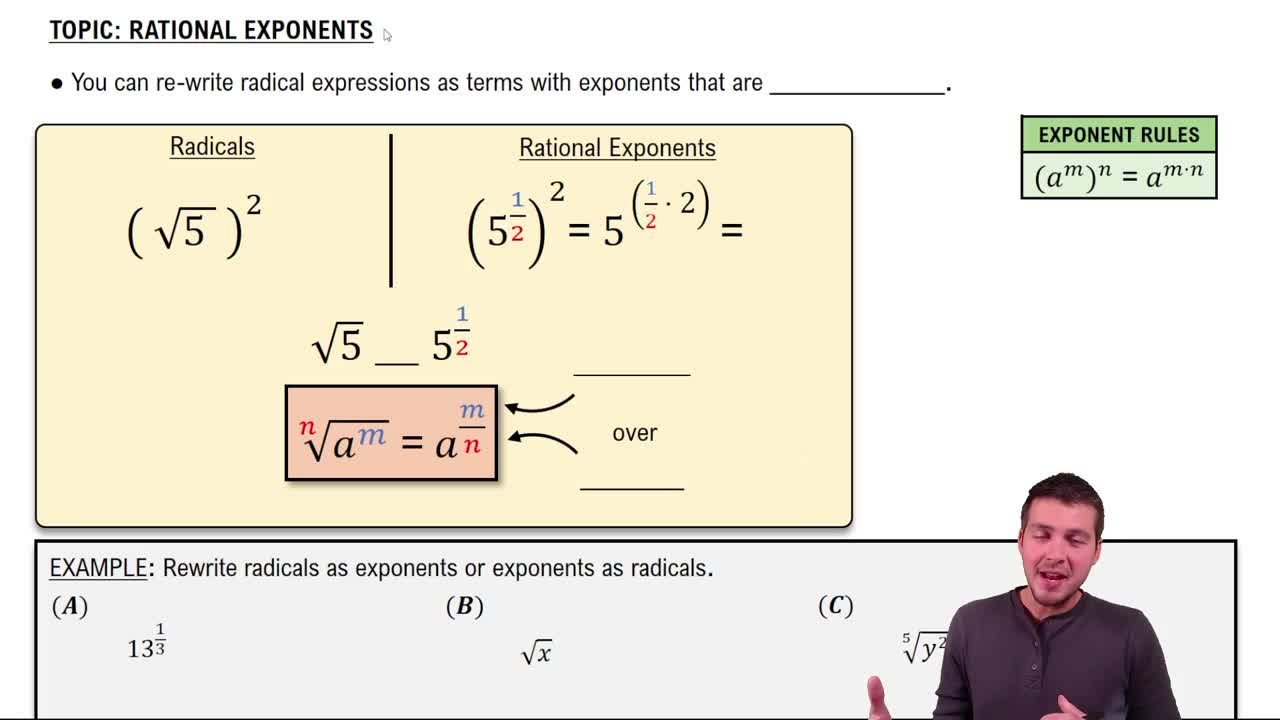
In polynomial functions, the exponents of the variable must be whole numbers (0, 1, 2, ...). Fractional or negative exponents indicate the function is not a polynomial. For instance, x^(1/3) is not allowed in polynomials because 1/3 is not an integer.
Recommended video:
Guided course
04:06
Rational Exponents

Degree of a Polynomial

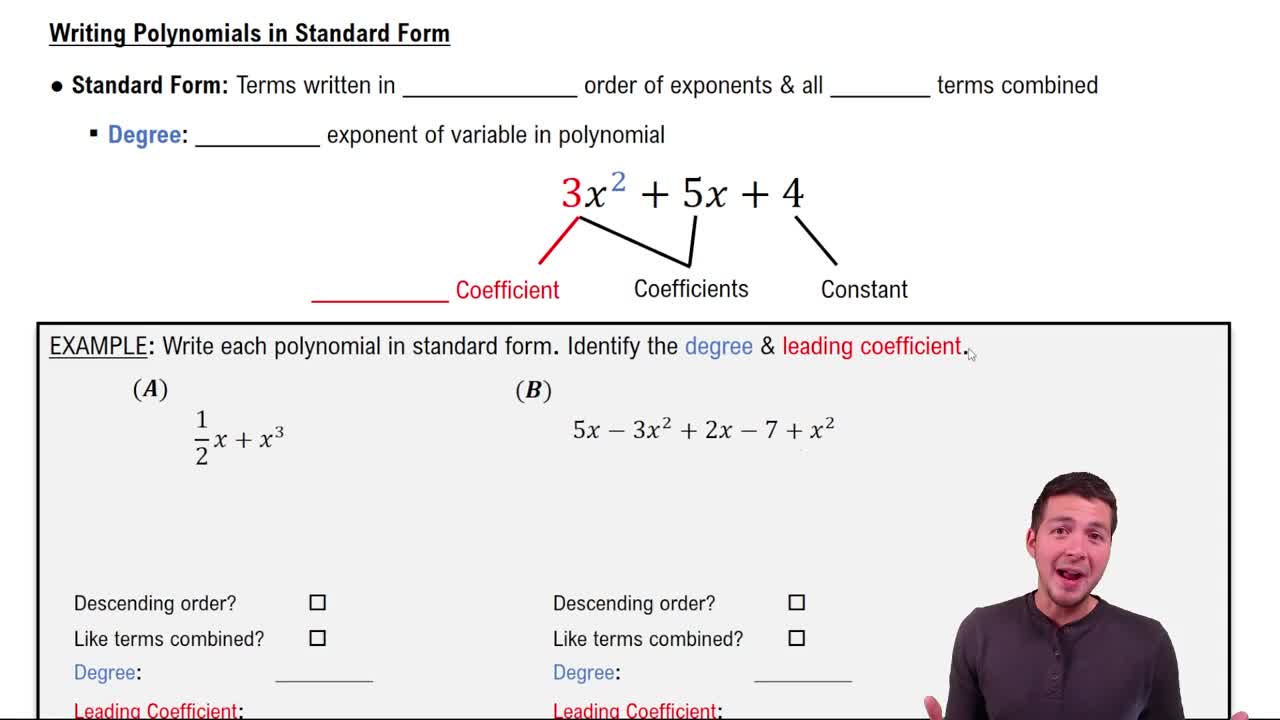
The degree of a polynomial is the highest exponent of the variable with a non-zero coefficient. It determines the general shape and behavior of the polynomial graph. For example, in f(x) = -4x^2 + 7, the degree is 2 because the highest power of x is 2.
Recommended video:
Guided course
05:16
Standard Form of Polynomials