What is the concentration of hydroxide ions 3OH-4 in a
glass of wine with pH = 3.64? (LO 16.5, 16.6)
(a) 2.3 * 10-4 M (b) 6.4 * 10-3 M
(c) 6.8 * 10-9 M (d) 4.4 * 10-11 M
Verified step by step guidance
1
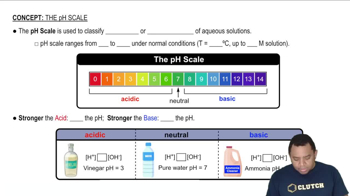
Step 1: Understand the relationship between pH and pOH. The pH and pOH of a solution are related by the equation: pH + pOH = 14.
Step 2: Calculate the pOH of the solution. Since the pH is given as 3.64, use the equation from Step 1 to find pOH: pOH = 14 - pH.
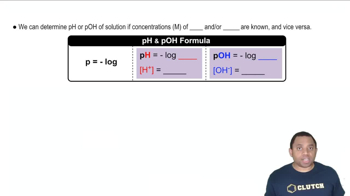
Step 3: Convert the pOH to the concentration of hydroxide ions [OH^-]. Use the formula: [OH^-] = 10^{-pOH}.
Step 4: Calculate the [OH^-] using the value of pOH obtained in Step 2.
Step 5: Compare the calculated [OH^-] with the given options to determine the correct answer.
Verified video answer for a similar problem:
This video solution was recommended by our tutors as helpful for the problem above.
Video duration:
1m
Play a video:
0 Comments
Key Concepts
Here are the essential concepts you must grasp in order to answer the question correctly.
pH and pOH Relationship
The pH scale measures the acidity or basicity of a solution, with lower values indicating higher acidity. The relationship between pH and pOH is given by the equation pH + pOH = 14 at 25°C. To find the concentration of hydroxide ions (OH-), one must first calculate the pOH from the given pH and then use the formula [OH-] = 10^(-pOH).
The concentration of ions in a solution can be determined using the formula [H+] = 10^(-pH) for hydrogen ions. Once the concentration of hydrogen ions is known, the concentration of hydroxide ions can be calculated using the ion product of water (Kw = [H+][OH-] = 1.0 x 10^-14 at 25°C). This relationship allows for the determination of hydroxide ion concentration from the known pH.
The pH scale is logarithmic, meaning each whole number change on the scale represents a tenfold change in hydrogen ion concentration. For example, a solution with a pH of 3 has ten times more hydrogen ions than a solution with a pH of 4. This property is crucial for accurately calculating ion concentrations from pH values, as small changes in pH can lead to significant differences in ion concentration.


 Verified step by step guidance
 02:09
02:09