
(a) The activation energy for the isomerization of methyl isonitrile (Figure 14.6) is 160 kJ>mol. Calculate the fraction of methyl isonitrile molecules that has an energy equal to or greater than the activation energy at 500 K. (b) Calculate this fraction for a temperature of 520 K. What is the ratio of the fraction at 520 K to that at 500 K?
Ch.14 - Chemical Kinetics
Brown14th EditionChemistry: The Central ScienceISBN: 9780134414232Not the one you use?Change textbook
Chapter 14, Problem 51a
(a) What factors determine whether a collision between two molecules will lead to a chemical reaction?
Verified step by step guidance1
Identify the kinetic energy of the colliding molecules. The molecules must have sufficient kinetic energy to overcome the activation energy barrier of the reaction.
Consider the orientation of the molecules during collision. The molecules must be oriented in a specific way that allows for the proper alignment of atoms that will bond together.
Examine the molecular structure and the presence of any functional groups that might influence the reaction pathway or the stability of the transition state.
Assess the reaction conditions such as temperature and pressure, as these can affect the kinetic energy of the molecules and the frequency of collisions.
Evaluate the presence of catalysts, which can lower the activation energy and change the required orientation for a successful reaction.

Verified video answer for a similar problem:
This video solution was recommended by our tutors as helpful for the problem above.
Video duration:
3mWas this helpful?
Key Concepts
Here are the essential concepts you must grasp in order to answer the question correctly.
Collision Theory
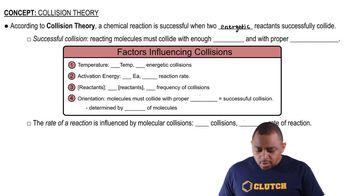
Collision theory posits that for a chemical reaction to occur, reactant molecules must collide with sufficient energy and proper orientation. The energy of the collision must be equal to or greater than the activation energy, which is the minimum energy required to initiate a reaction. Additionally, the orientation of the colliding molecules must allow for the formation of new bonds.
Recommended video:
Guided course
Collision Theory
Activation Energy
Activation energy is the energy barrier that must be overcome for a reaction to proceed. It represents the minimum energy required for reactants to transform into products. Factors such as temperature and the presence of catalysts can influence the activation energy, thereby affecting the rate of the reaction by increasing the number of effective collisions.
Recommended video:
Guided course
Activity Series Chart
Molecular Orientation
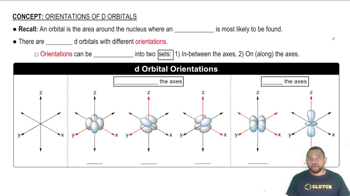
Molecular orientation refers to the specific alignment of molecules during a collision. For a reaction to occur, the molecules must collide in a way that allows for the breaking and forming of bonds. This means that certain orientations are more favorable than others, and understanding these orientations can help predict the likelihood of a reaction occurring during molecular collisions.
Recommended video:
Guided course
d Orbital Orientations
Related Practice
Textbook Question
1360
views
Textbook Question
The gas-phase decomposition of NO2, 2 NO2(g) → 2 NO(g) + O2(g), is studied at 383°C, giving the following data:
Time (s) [NO2] (M)
0.0 0.100
5.0 0.017
10.0 0.0090
15.0 0.0062
20.0 0.0047
(a) Is the reaction first order or second order with respect to the concentration of NO2?
(c) Predict the reaction rates at the beginning of the reaction for initial concentrations of 0.200 M, 0.100 M, and 0.050 M NO2.
1744
views
Textbook Question
Calculate the fraction of atoms in a sample of argon gas at 400 K that has an energy of 10.0 kJ or greater.
1657
views
1
rank
