
Textbook Question
(b) Does the rate constant for a reaction generally increase or decrease with an increase in reaction temperature?
454
views



 Verified step by step guidance
 02:02
02:02
 00:54
00:54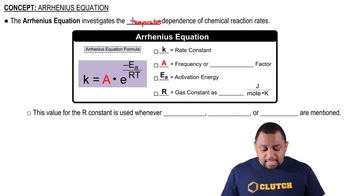 01:20
01:20(b) Does the rate constant for a reaction generally increase or decrease with an increase in reaction temperature?
Calculate the fraction of atoms in a sample of argon gas at 400 K that has an energy of 10.0 kJ or greater.
The gas-phase reaction Cl(g) + HBr(g) → HCl(g) + Br(g) has an overall energy change of -66 kJ. The activation energy for the reaction is 7 kJ. (a) Sketch the energy profile for the reaction, and label Ea and ΔE.
The gas-phase reaction Cl(g) + HBr(g) → HCl(g) + Br(g) has an overall energy change of -66 kJ. The activation energy for the reaction is 7 kJ. (b) What is the activation energy for the reverse reaction?