For each of the following reactions, write a balanced equation, calculate the standard emf, calculate ∆G° at 298 K, and calculate the equilibrium constant K at 298 K. (a) Aqueous iodide ion is oxidized to I21s2 by Hg22+1aq2.
Ch.20 - Electrochemistry
Brown14th EditionChemistry: The Central ScienceISBN: 9780134414232Not the one you use?Change textbook
Chapter 20, Problem 51a
Given the following reduction half-reactions:
Fe3+(aq) + e- → Fe2+(aq) E°red = +0.77 V
S2O62-(aq) + 4 H+(aq) + 2 e- → 2 H2SO3(aq) E°red = +0.60 V
N2O(g) + 2 H+(aq) + 2 e- → N2(g) + H2O(l) E°red = -1.77 V
VO2+(aq) + 2 H+(aq) + e- → VO2+ + H2O(l) E°red = +1.00 V
(a) Write balanced chemical equations for the oxidation of Fe2+(aq) by S2O62-(aq), by N2O(aq), and by VO2+(aq).
Verified step by step guidance1
Identify the reduction half-reactions given in the problem and their respective standard reduction potentials (E°).
Determine the oxidation half-reaction for Fe^{2+} by reversing the given reduction half-reaction: Fe^{2+} \(\rightarrow\) Fe^{3+} + e^{-}.
For each oxidizing agent (S_2O_6^{2-}, N_2O, VO_2^{+}), write the corresponding reduction half-reaction as given in the problem.
Combine the oxidation half-reaction of Fe^{2+} with each reduction half-reaction to form a balanced redox equation. Ensure that the number of electrons lost in the oxidation half-reaction equals the number of electrons gained in the reduction half-reaction.
Balance the overall chemical equation for each reaction by ensuring that the number of atoms and the charge are balanced on both sides of the equation.

Verified video answer for a similar problem:
This video solution was recommended by our tutors as helpful for the problem above.
Video duration:
11mWas this helpful?
Key Concepts
Here are the essential concepts you must grasp in order to answer the question correctly.
Oxidation-Reduction Reactions
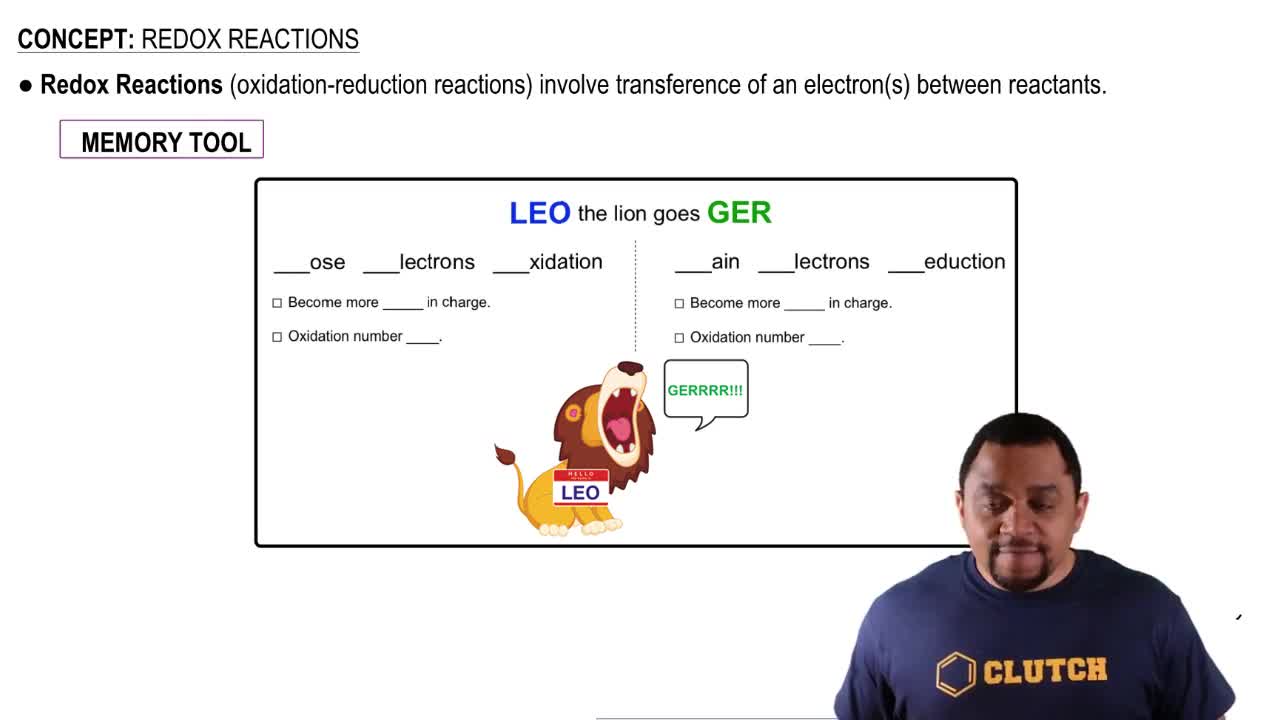
Oxidation-reduction (redox) reactions involve the transfer of electrons between species, where oxidation refers to the loss of electrons and reduction refers to the gain of electrons. In these reactions, the species that loses electrons is oxidized, while the one that gains electrons is reduced. Understanding the roles of oxidizing and reducing agents is crucial for balancing redox equations.
Recommended video:
Guided course
Oxidation and Reduction Reactions
Standard Electrode Potentials (E°)
Standard electrode potentials (E°) are measured under standard conditions and indicate the tendency of a species to be reduced. A higher E° value means a greater likelihood of reduction occurring. In redox reactions, comparing the E° values of the half-reactions helps determine which species will oxidize and which will reduce, guiding the balancing of the overall reaction.
Recommended video:
Guided course
Standard Cell Potential
Balancing Redox Reactions
Balancing redox reactions involves ensuring that both mass and charge are conserved. This typically requires separating the reaction into half-reactions for oxidation and reduction, balancing each for atoms and charge, and then combining them. The use of coefficients and the adjustment of electrons transferred are essential steps in achieving a balanced equation.
Recommended video:
Guided course
Balancing Basic Redox Reactions
Related Practice
Textbook Question
623
views
1
rank
Textbook Question
Given the following reduction half-reactions:
Fe3+(aq) + e- → Fe2+(aq) E°red = +0.77 V
S2O62-(aq) + 4 H+(aq) + 2 e- → 2 H2SO3(aq) E°red = +0.60 V
N2O(g) + 2 H+(aq) + 2 e- → N2(g) + H2O(l) E°red = -1.77 V
VO2+(aq) + 2 H+(aq) + e- → VO2+ + H2O(l) E°red = +1.00 V
(b) Calculate ∆G° for each reaction at 298 K.
369
views
Textbook Question
Given the following reduction half-reactions:
Fe3+(aq) + e- → Fe2+(aq) E°red = +0.77 V
S2O62-(aq) + 4 H+(aq) + 2 e- → 2 H2SO3(aq) E°red = +0.60 V
N2O(g) + 2 H+(aq) + 2 e- → N2(g) + H2O(l) E°red = -1.77 V
VO2+(aq) + 2 H+(aq) + e- → VO2+ + H2O(l) E°red = +1.00 V
(c) Calculate the equilibrium constant K for each reaction at 298 K.
1
views
Textbook Question
(b) Arrange the following in order of increasing strength as reducing agents in acidic solution: Zn, I-, Sn2+, H2O2, Al.