
Textbook Question
Consider the H2+ ion. (c) Write the electron configuration of the ion in terms of its MOs. (d) What is the bond order in H2+?
883
views



 Verified step by step guidance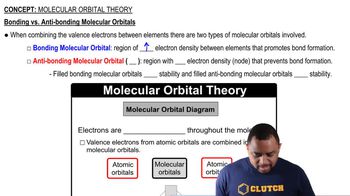
 03:06
03:06
 00:53
00:53 03:37
03:37Consider the H2+ ion. (c) Write the electron configuration of the ion in terms of its MOs. (d) What is the bond order in H2+?
Consider the H2+ ion. (e) Suppose that the ion is excited by light so that an electron moves from a lower-energy to a higher-energy MO. Would you expect the excited-state H2+ ion to be stable or to fall apart?
Consider the H2+ ion. (f) Which of the following statements about part (e) is correct: (i) The light excites an electron from a bonding orbital to an antibonding orbital, (ii) The light excites an electron from an antibonding orbital to a bonding orbital, or (iii) In the excited state there are more bonding electrons than antibonding electrons?
(c) Calculate the bond order in H2-.
Draw a picture that shows all three 2p orbitals on one atom and all three 2p orbitals on another atom. (a) Imagine the atoms coming close together to bond. How many σ bonds can the two sets of 2p orbitals make with each other?
Draw a picture that shows all three 2p orbitals on one atom and all three 2p orbitals on another atom. (b) How many p bonds can the two sets of 2p orbitals make with each other?