For each of the following equilibria, write the equilibrium constant expression for Kc. Where appropriate, also write the equilibrium constant expression for Kp. (a) Fe2O31s2 + 3 CO1g2 ∆ 2 Fe1l2 + 3 CO21g2
Verified step by step guidance
1
Identify the balanced chemical equation: \( \text{Fe}_2\text{O}_3(s) + 3 \text{CO}(g) \rightleftharpoons 2 \text{Fe}(l) + 3 \text{CO}_2(g) \).
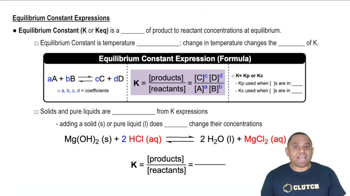
Recognize that the equilibrium constant expression \( K_c \) is based on the concentrations of gases and aqueous solutions, excluding pure solids and liquids.
Write the expression for \( K_c \) using the concentrations of the gaseous species: \( K_c = \frac{[\text{CO}_2]^3}{[\text{CO}]^3} \).
For \( K_p \), use the partial pressures of the gases: \( K_p = \frac{(P_{\text{CO}_2})^3}{(P_{\text{CO}})^3} \).
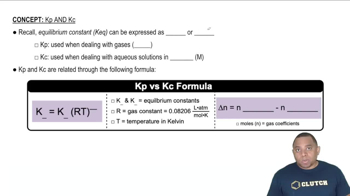
Note that \( K_p \) and \( K_c \) are related by the equation \( K_p = K_c(RT)^{\Delta n} \), where \( \Delta n \) is the change in moles of gas (\( \Delta n = 3 - 3 = 0 \) in this case).
Verified video answer for a similar problem:
This video solution was recommended by our tutors as helpful for the problem above.
Video duration:
2m
Play a video:
0 Comments
Was this helpful?
Key Concepts
Here are the essential concepts you must grasp in order to answer the question correctly.
Equilibrium Constant (Kc and Kp)
The equilibrium constant (K) quantifies the ratio of the concentrations of products to reactants at equilibrium for a reversible reaction. Kc is used when concentrations are expressed in molarity (M), while Kp is used when dealing with partial pressures of gases. The relationship between Kc and Kp is given by the equation Kp = Kc(RT)Δn, where Δn is the change in moles of gas.
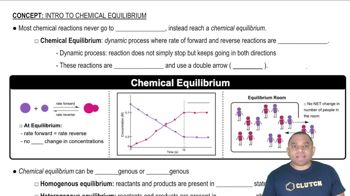
Chemical equilibrium occurs when the rates of the forward and reverse reactions are equal, resulting in constant concentrations of reactants and products. At this point, the system is dynamic, meaning that reactions continue to occur, but there is no net change in concentration. Understanding this concept is crucial for writing equilibrium expressions accurately.
The stoichiometry of a balanced chemical equation dictates how to write the equilibrium constant expression. The coefficients of the balanced equation become the exponents in the K expression. For example, in the reaction aA + bB ⇌ cC + dD, the equilibrium expression is Kc = [C]^c[D]^d / [A]^a[B]^b, emphasizing the importance of the stoichiometric coefficients.



 Verified step by step guidance
 02:06
02:06