The interconversion of l-___-lysine and l-b-lysine, for which Kc = 7.20 at 333 K, is catalyzed by the enzyme lysine 2,3-aminomutase. Lysine occurs in proteins while l-b-lysine is a precursor to certain antibiotics. At 333 K, a solution of l-___-lysine at a concentration of 3.00 * 10^-3 M is placed in contact with lysine 2,3-aminomutase. What are the equilibrium concentrations of l-___-lysine and l-b-lysine?
Verified step by step guidance
1
Identify the initial concentration of l-\_\_\_-lysine, which is given as 3.00 \times 10^{-3} \text{ M}.
Write the balanced chemical equation for the interconversion: l-\_\_\_-lysine \rightleftharpoons l-b-lysine.
Define the change in concentration for each species using an ICE (Initial, Change, Equilibrium) table. Let x be the change in concentration of l-b-lysine formed at equilibrium.
Express the equilibrium concentrations in terms of x: [l-\_\_\_-lysine] = 3.00 \times 10^{-3} - x \text{ M} and [l-b-lysine] = x \text{ M}.
Use the equilibrium constant expression K_c = \frac{[l-b-lysine]}{[l-\_\_\_-lysine]} = 7.20 to solve for x, which will give the equilibrium concentrations of both species.
Key Concepts
Here are the essential concepts you must grasp in order to answer the question correctly.
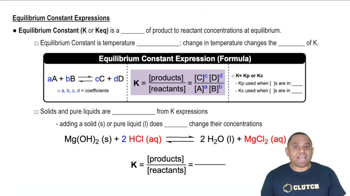
Equilibrium Constant (Kc)
The equilibrium constant (Kc) is a numerical value that expresses the ratio of the concentrations of products to reactants at equilibrium for a given reaction at a specific temperature. It provides insight into the extent of a reaction; a Kc greater than 1 indicates that products are favored, while a Kc less than 1 suggests that reactants are favored. In this case, Kc = 7.20 indicates that at equilibrium, l-b-lysine will be present in a higher concentration compared to l-___-lysine.
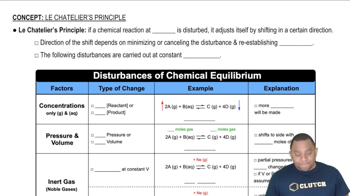
Le Chatelier's Principle states that if a dynamic equilibrium is disturbed by changing the conditions, the system will adjust itself to counteract the change and restore a new equilibrium. This principle is crucial in predicting how changes in concentration, temperature, or pressure will affect the equilibrium position of the reaction between l-___-lysine and l-b-lysine when catalyzed by lysine 2,3-aminomutase.
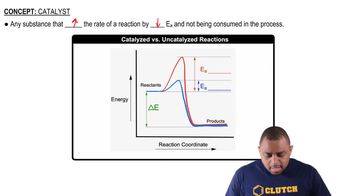
Catalysis is the process by which the rate of a chemical reaction is increased by a substance called a catalyst, which is not consumed in the reaction. In this scenario, the enzyme lysine 2,3-aminomutase acts as a catalyst, facilitating the interconversion of l-___-lysine and l-b-lysine without altering the equilibrium concentrations. Understanding the role of the catalyst is essential for analyzing the kinetics and dynamics of the reaction.