Arrange the following substances in order of increasing H3O+ concentration for a 0.10 M solution of each. (a) Zn(NO3)2 (b) Na2O (c) NaOCl (d) NaClO4 (e) HClO4
Verified step by step guidance
1
Identify the nature of each substance: Determine if each substance is an acid, base, or neutral salt. This will help predict how they affect the H3O+ concentration in solution.
Consider the dissociation of each substance in water: Write the chemical equation for the dissociation of each compound in water to understand the ions produced.
Evaluate the effect on H3O+ concentration: For acids, consider how they increase H3O+ concentration. For bases, consider how they decrease H3O+ concentration by producing OH- ions. Neutral salts typically do not affect H3O+ concentration significantly.
Rank the substances: Based on the dissociation and the nature of each substance, arrange them in order of increasing H3O+ concentration.
Check for strong acids or bases: Identify if any of the substances are strong acids or bases, as they will have a more significant impact on the H3O+ concentration compared to weak acids or bases.
Key Concepts
Here are the essential concepts you must grasp in order to answer the question correctly.
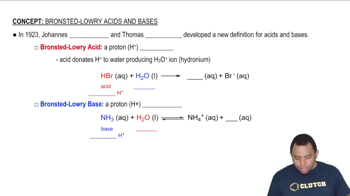
Acid-Base Theory
Acid-base theory explains how substances can donate or accept protons (H+ ions). Strong acids, like HClO4, completely dissociate in water, increasing H3O+ concentration significantly. In contrast, weak acids or neutral salts do not contribute to H3O+ concentration as effectively, making this theory essential for understanding the behavior of the given substances.
Ionic compounds dissociate into their constituent ions when dissolved in water. For example, Zn(NO3)2 dissociates into Zn²+ and NO3- ions, while Na2O reacts with water to form Na+ and OH- ions. The extent of dissociation and the nature of the ions produced influence the resulting H3O+ concentration in the solution.
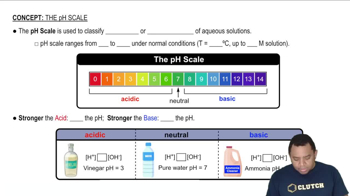
The pH scale measures the acidity or basicity of a solution, with lower pH values indicating higher H3O+ concentrations. The relationship between pH and H3O+ is logarithmic, meaning that a small change in pH corresponds to a significant change in H3O+ concentration. Understanding this relationship is crucial for arranging the substances based on their H3O+ levels.